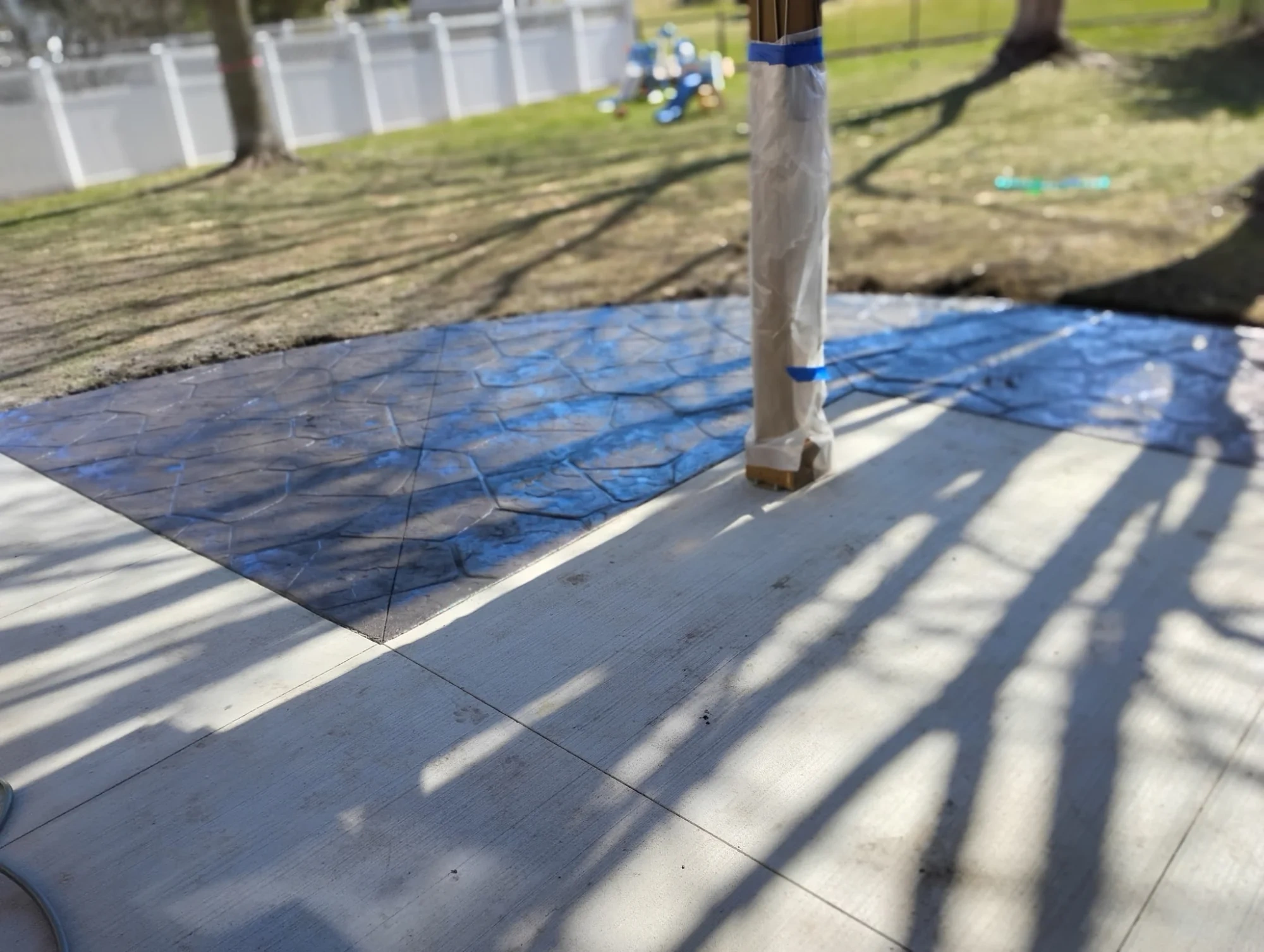
Concrete survives Minnesota winters because it is engineered to, not because it happens to. An air-entrained mix puts microscopic bubbles in the paste that give freezing water room to expand without cracking the concrete. The slab has to reach about 500 psi, usually 24 to 48 hours after the pour, before it can take its first freeze. Standing water and the wrong de-icers undo all of that. Get the mix, the cure, and the drainage right and the slab can run forty years. Get them wrong and it scales out in three.
How Many Freeze-Thaw Cycles a Rochester Slab Actually Sees
Freeze-thaw is not a once-a-winter event here. Olmsted County concrete crosses the freezing line dozens of times a year, often dozens of times in a single shoulder-season month, when daytime sun thaws the surface and overnight cold refreezes it. Each one of those cycles is a small mechanical event inside the concrete. Water that has soaked into the surface freezes, expands, and pushes. Then it thaws and the next cycle reloads the same spot. Over a winter that is dozens of expansion events. Over a slab’s life it is hundreds and hundreds. This is the single hardest thing concrete deals with in this climate, harder than load, harder than time. A slab that is not built to absorb that repeated expansion is a slab on a countdown.
What Air Entrainment Does, and Why It Is Not Optional Here
Air-entrained concrete has a controlled amount of microscopic air bubbles distributed through the cement paste. They are not visible and they are not the same as the larger voids you get from poor mixing or placement. These engineered bubbles are tiny, evenly spread pressure-relief chambers. When water inside the concrete freezes and expands, it has somewhere to go, into those bubbles, instead of building pressure against the rigid paste around it. That released pressure is the difference between a slab that shrugs off a freeze and one that fractures from the inside. Every slab we pour for this climate is air-entrained. It is not an upgrade we offer; it is the baseline for concrete that is expected to live outdoors in Minnesota. A contractor pouring non-air-entrained concrete for an exterior slab here is pouring concrete that does not have the one feature that lets it survive.
The First Freeze: Why Cure Time Before It Matters So Much
Fresh concrete is mostly water, and if that water freezes before the concrete has gained enough strength, the expanding ice tears apart the structure while it is still forming. The slab never develops the strength it was designed for, and the damage is permanent and invisible until it starts failing. The threshold is roughly 500 psi. Concrete needs to reach that minimum strength before it can safely take a freeze, and under normal conditions that takes about 24 to 48 hours after placement. This is why timing a late-season pour against the forecast is not paranoia. If a hard freeze is coming the night of a pour, the concrete has not had its day or two to gain strength, and protecting it is the difference between a good slab and a ruined one. Pouring with no plan for that first freeze is one of the fastest ways to wreck otherwise good concrete.
What Surface Scaling Looks Like and Why It Happens
Scaling is the most common visible freeze-thaw failure, and once you know it you see it everywhere on bad slabs. The surface flakes and peels away in thin layers, exposing the aggregate underneath and leaving a rough, pitted, crumbling top. It usually starts at the surface and works down, and it is ugly long before it is structural. Scaling happens when the near-surface paste cannot handle freeze-thaw expansion, either because the concrete was not air-entrained, because de-icers drove extra chloride and moisture into the surface, because the surface was overworked during finishing and sealed off its own air void system, or because it froze before it cured. A non-air-entrained slab in this climate often looks fine through year one, shows the first scaling in year two, and by year three has a surface that is visibly breaking apart. A properly air-entrained, well-cured, well-drained slab in the same yard, same weather, is still smooth and intact. The weather did not pick favorites. The engineering did.
De-Icers: What to Use and What to Keep Off Your Slab
De-icers are where homeowners do real damage to good concrete without realizing it. Chloride-based de-icers are the problem. Calcium chloride is among the most aggressive, it works at very low temperatures and drives chloride hard into the concrete surface, accelerating scaling and surface breakdown, and it is rough on a slab in its first couple of winters especially. Rock salt, which is sodium chloride, is gentler than calcium chloride but still a chloride and still works moisture and salt into the surface in ways that speed freeze-thaw damage. The safest tool is the simplest: sand or traction grit. It does not melt ice chemically, it just gives you grip, and it does nothing harmful to the concrete. On a new slab, sand for traction through at least the first two winters. After that, if you use any chloride de-icer, use it sparingly and never the aggressive calcium chloride products. We would rather you scatter a bag of sand than melt your way through the surface of a slab we just poured.
Protecting a New Slab Through Its First Winter
A slab poured in the warm season has months to cure and harden before it faces winter, and the main thing it needs is to stay sealed and de-icer-free that first season. A slab poured late, close to or into the cold, needs active protection, and that is where blankets come in. Insulating concrete blankets are laid over a fresh late-season pour to hold the heat of the curing reaction in and keep the slab above freezing while it gains its early strength. The blanket traps the warmth the concrete generates as it cures, buys the slab the day or two it needs to pass that 500 psi threshold, and gets it through the first cold nights without freezing. On a late-season pour we blanket as a matter of course and monitor it. That is what responsible cold-season concrete work looks like: the pour is planned around the weather and the slab is protected through its most vulnerable hours, not left to chance.
When It Is Simply Too Cold to Pour
There is a point where no amount of blanketing makes a pour a good idea, and an honest contractor will tell you when you have hit it. When sustained temperatures sit deep below freezing with no warm window in the forecast, the ground is frozen, the materials fight the cold the whole time, and the risk of a compromised slab climbs past what protection can manage. Past that threshold, the right answer is to wait. A contractor who pours anyway because the schedule says so, or because they want the deposit before spring, is gambling with your slab to protect their calendar. We will tell you straight if your project should wait for conditions instead of being forced into a deep freeze. A slab is a thirty-to-fifty-year decision and it is not worth wrecking to save a few weeks.
Forty Good Years Versus Ten Bad Ones
The clearest way to understand all of this is to look at two driveways. A well-specced forty-year-old Minnesota concrete driveway, air-entrained, on a proper compacted and drained base, cured correctly, kept off the calcium chloride, still has a sound, intact surface. It has hairline cracks held tight at the control joints, the color has weathered, and it is doing the job it was built for after four decades of the worst freeze-thaw in the country. A poorly-specced ten-year-old driveway in the same town, non-air-entrained or poured on a bad base and salted hard every winter, is already scaling, cracking randomly, offsetting at the cracks, and spalling at the edges. Same climate, same number of freeze cycles, completely different outcome. The difference was never the weather. It was the mix, the base, the cure, and the de-icing, decided before and just after the pour. That is the whole argument for paying attention to how concrete is engineered for this climate instead of treating one slab as the same as any other.
Frequently Asked Questions
How late in the year can you pour concrete in Minnesota?
It depends on the forecast more than the calendar. We pour into the cold season using insulating blankets to protect the slab through its first critical days, as long as there is a workable window to get the concrete past its early strength gain. When sustained deep cold sets in with no warm break coming, we will tell you the honest answer is to wait until conditions come back rather than risk a compromised slab.
Why is my older driveway flaking on the surface?
That is surface scaling, and it is the classic freeze-thaw failure. It usually means the concrete was not air-entrained, or it took heavy chloride de-icer exposure, or it froze before it cured. Once a surface is scaling it is hard to reverse, though a resurfacing or overlay can sometimes restore it depending on how deep the damage runs. We can look at it and tell you whether it is cosmetic or structural.
Is it safe to use any de-icer on concrete?
Sand and traction grit are always safe because they do not melt ice chemically, they just provide grip. Keep aggressive chloride de-icers, especially calcium chloride, off your concrete, and keep all chloride de-icers off a new slab through its first two winters. After that, if you use rock salt at all, use it sparingly. The de-icer choice is one of the biggest things in your control for how long the surface lasts.
How long until a new slab can take its first freeze?
The slab needs to reach roughly 500 psi before a freeze is safe, which under normal conditions is about 24 to 48 hours after the pour. That is why a late-season pour is timed against the forecast and protected with blankets if cold is coming. Freezing before that strength threshold causes permanent internal damage that shows up later as scaling and weakness.
Ready to Talk About Your Project?
We pour concrete in Rochester, Stewartville, Byron, Owatonna, and throughout southern Minnesota. Free walkthrough, itemized quote.