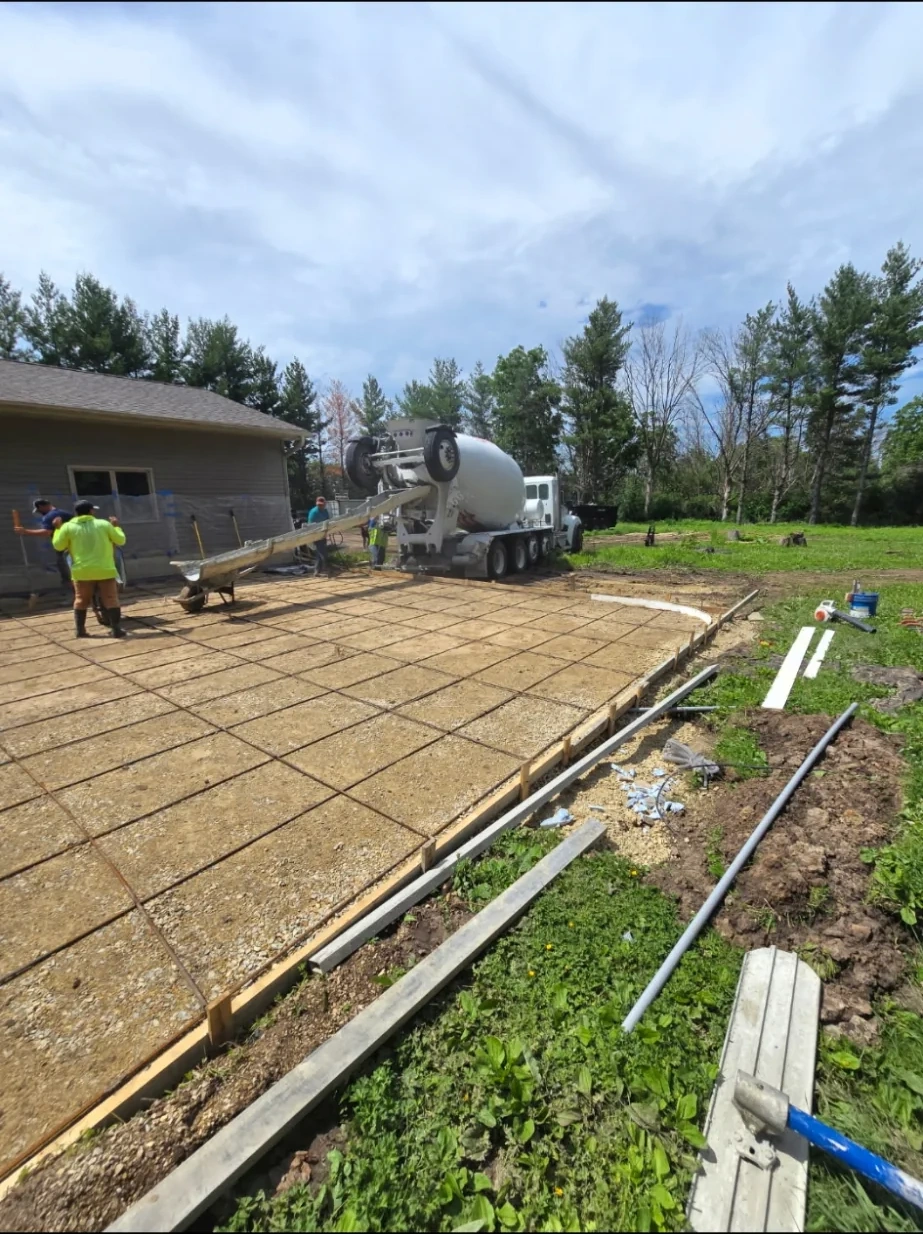
Wire mesh ends up at the bottom of the slab because the crew walks it down during the pour, which puts the steel in the wrong place to do any work. Half-inch rebar set on chairs stays at mid-slab where the tensile stress actually lives. Our standard on every slab is half-inch rebar, 16-inch centers, tied at every intersection and lifted on chairs. It costs more than mesh, and it is already in the number we quote you.
Where the Steel Sits Is the Whole Game
Concrete is strong in compression and weak in tension. Push down on it and it holds. Pull it apart or bend it, and it fails. Every slab on grade flexes a little under load and a little more as the ground beneath it moves through the seasons. When a slab bends, the top face goes into compression and the bottom face goes into tension. Reinforcing steel exists to carry that tension so the concrete does not have to. The catch is that steel only does that job if it sits where the tension is, and on a slab that flexes both ways across its life, the tension zone runs through the middle of the slab thickness. Steel at mid-slab carries tension whether the slab cups up or sags down. Steel pinned to the bottom carries tension in one bending direction and does almost nothing in the other.
This is why placement is not a detail. You can put the right amount of steel in a slab and get no structural benefit from it if that steel ends up in the wrong third of the slab. Reinforcement that is sitting on the subgrade when the concrete goes over it is reinforcement you paid for and will not get the use of.
Why Wire Mesh Almost Always Ends Up at the Bottom
Wire mesh comes in rolls or flat sheets of thin welded wire. The plan, in theory, is that it floats at mid-slab. The reality on a pour is that mesh is light, springy, and impossible to keep elevated once people and concrete are moving across it. The crew has to walk the pour to place and screed the concrete. Every boot step pushes the mesh down into the wet mix and the gravel base. Once it is down, it stays down, because there is nothing holding it up. By the time the slab is finished, the mesh that was supposed to be in the middle is lying on the subgrade, two or three inches below where it needed to be. We have broken open failed slabs and found the mesh sitting right on the dirt, doing nothing.
Some crews try to fix this on the fly by hooking the mesh and pulling it up as they go, sometimes called hooking or pull-up. It is better than nothing and it is also inconsistent. You get steel that is at mid-slab in some spots and on the bottom in others, which means the reinforcement is unreliable across the slab. For a structure you want to last decades in this climate, unreliable is not a spec we are willing to sign our name to.
What Happens to a Bottom-Reinforced Slab Over Ten Minnesota Winters
A slab in Olmsted County goes through dozens of freeze-thaw cycles a year. The ground heaves and settles, moisture moves in and out of the base, and the slab flexes over all of it. A slab with steel correctly placed at mid-slab bridges that movement. Small cracks that form get held tight by the steel and stay hairline. The slab keeps working as one piece. A slab with steel stuck at the bottom has nothing carrying tension when the slab cups upward, which is exactly what happens when the edges settle or the center heaves. Cracks open at the surface, widen with each freeze cycle, and the two sides of the crack start to move independently. That is when you get the stair-step offset where one side of a crack sits higher than the other, which is both a trip hazard and the beginning of the end for that slab.
The timeline is rarely dramatic. The slab looks fine for the first couple of years. Around year three to five the first cracks show. By year eight to ten the cracks have opened, offset, and started to spall at the edges. The owner thinks the concrete was bad. The concrete was fine. The steel was in the wrong place from day one.
The Cost Difference, and Why It Is Already in Your Quote
Half-inch rebar on chairs costs more than wire mesh. The material is more, and the labor is more because someone has to lay out the grid, tie every intersection, and set the chairs before any concrete shows up. On a typical residential slab the upgrade from mesh to a proper rebar grid adds a few hundred dollars to a project, depending on size. That number is real and we are not going to pretend it is not.
Here is why it is already in every quote we hand you: a slab is a thirty-to-fifty-year investment, and the reinforcement is the part you cannot fix later. You can reseal a surface, you can recaulk a joint, you can grind a high spot. You cannot go back and move the steel. Saving a few hundred dollars on mesh to risk a slab that fails a decade early is a bad trade, and we are not going to set you up for it to win a bid. If another contractor’s number comes in lower, ask what reinforcement they are using and where it sits. That is usually where the difference is.
What to Ask a Contractor Who Quotes Mesh
If a quote specifies wire mesh, you are allowed to push on it. Ask three questions. First: how will the mesh be held at mid-slab during the pour? If the answer is hooking or pulling it up by hand, you now know the placement will be inconsistent. Second: what is the reinforcement spacing and bar size, and is it tied? A real answer sounds like half-inch bar at sixteen-inch centers, tied at intersections, on chairs. Vague answers are a flag. Third: will you set chairs to support the steel? Chairs are small plastic or wire supports that hold reinforcement at the right height so it does not get walked down. No chairs means the steel is going to the bottom no matter what anyone intends.
How to Inspect Reinforcement Before the Pour
You do not need to be an engineer to check this yourself the morning of the pour, before any concrete arrives. Walk the forms. You should see a grid of steel bars, not a single sheet of thin wire. The bars should sit up off the gravel on chairs, not lying flat on the base. Reach down and you should not be able to easily push the steel to the dirt. The intersections should be tied with wire so the grid holds its shape when the crew walks it. If the steel is lifted, gridded, and tied, you are watching a slab get built to last. If it is lying on the base, stop and ask why before the truck shows up, because once concrete is over it, there is nothing anyone can do.
Frequently Asked Questions
Is wire mesh ever acceptable in a slab?
For lightly loaded, non-structural slabs where some cracking is acceptable, mesh held properly at mid-slab can do a job. The problem is almost never the mesh itself. It is that mesh is nearly impossible to keep at the correct height during a real pour. For driveways, garage floors, patios, and anything you want to last in Minnesota freeze-thaw, we use half-inch rebar on chairs because we can guarantee where it ends up.
What does “on chairs” actually mean?
Chairs are small plastic or wire supports that hold the rebar grid up off the gravel base at the correct height, usually so the steel sits near the middle of the slab thickness. Without chairs, the steel rests on the base and the crew walks it into the bottom of the pour. Chairs are cheap and they are the difference between steel that works and steel that just adds weight.
Why 16-inch centers and not wider?
Sixteen-inch centers give a tight enough grid to control cracking across the whole slab and distribute load evenly, without over-building. Wider spacing leaves larger unreinforced areas between bars where cracks can open. For most residential and light commercial slabs, half-inch bar at sixteen inches each way is a proven spec that holds up to decades of freeze-thaw.
Can you tell from the surface whether a slab has rebar or mesh?
Not by looking at a finished slab, no. That is exactly why inspecting before the pour matters. Once concrete is placed, the reinforcement is hidden for the life of the slab. The only honest way to know what is in your slab and where it sits is to look at the steel in the forms before the truck arrives, which we encourage every customer to do.
Ready to Talk About Your Project?
We pour concrete in Rochester, Stewartville, Byron, Owatonna, and throughout southern Minnesota. Free walkthrough, itemized quote.