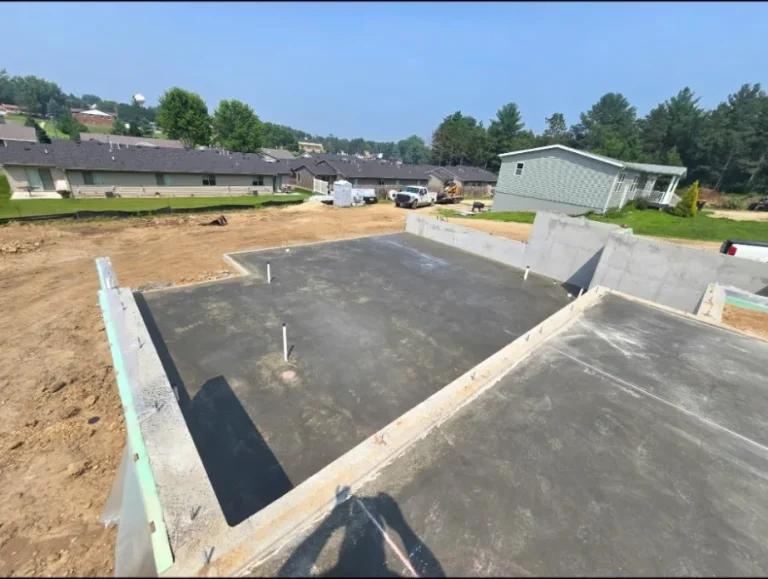
What Is Loading Dock Construction
Concrete engineered for truck-grade impact, chemical runoff, and freeze-thaw cycles specific to southeast Minnesota winters.
A loading dock is the interface between your facility and your supply chain. It takes everything from semi trucks backing in at 50,000 pounds to forklifts cycling in and out dozens of times a day. Standard residential or even light commercial concrete mixes simply are not built for that kind of repetitive impact. Loading dock construction requires site engineering, correct slab thickness, heavy rebar or wire mesh reinforcement, the right concrete mix design, control joint placement to manage cracking, and a dock apron profile that handles drainage while still giving trucks a clean approach angle.
In Rochester, MN, we deal with a freeze-thaw cycle that can crack an under-designed slab in two to three winters. The ground heaves, water infiltrates control joints, and if the concrete lacks adequate air entrainment and proper curing, you end up with spalling and structural damage that compounds every season. Pouring Praises designs every loading dock slab with southeast Minnesota winters in mind: air-entrained mix, sealed control joints, and slab slopes that keep meltwater moving away from the dock face and out of the structure.
We work with warehouses, distribution centers, manufacturing facilities, cold storage operations, and commercial properties throughout Rochester and Olmsted County. Whether you need a new dock from raw grade, a replacement of a failed slab, or a dock extension to accommodate larger trucks, we handle the full scope: site prep, form work, reinforcement, pour, finish, and cure. Every project is reviewed on-site before we spec anything. Reach out to schedule your site visit.
Why Businesses Choose Pouring Praises
Loading dock failures do not announce themselves early. By the time a surface crack becomes a structural problem, you are looking at operational downtime and replacement costs that dwarf what prevention would have cost. Here is what we bring to every project that makes the difference.
Mix Design Matched to Load Demands
Consumer-grade mixes top out around 3,000 PSI. Loading dock slabs in active freight environments need 4,000 to 5,000 PSI minimum, with the right water-cement ratio and aggregate size for your specific traffic pattern. We source mix from established regional plants and specify the design before a single yard is ordered.
Cold-Climate Engineering
Rochester averages over 45 inches of snow annually. The freeze-thaw cycle here is among the most punishing in the Midwest for concrete surfaces. Air-entrained concrete, proper curing blankets in colder pours, and sealed control joints are not optional on a Minnesota loading dock. They are what separates a slab that lasts 25 years from one that needs patching after year three.
On-Site Review Before Any Commitment
We do not quote loading dock work off a phone call and a square-footage number. The existing grade, drainage patterns, soil bearing capacity, proximity to utilities, and your truck traffic profile all affect how the dock is engineered. We walk the site, take measurements, and price the actual project, not an imaginary one. Schedule a site visit here.
Local, Insured, and Accountable
Pouring Praises is Rochester-based and fully insured. We are not a regional chain routing leads to transient subcontractors. You work directly with the crew that pours your dock. If anything needs attention after the cure, we are a local call away, not a customer service queue in another state.
How We Build Your Loading Dock
Site Assessment and Engineering
We start with an on-site review of your existing grade, drainage, soil conditions, and truck approach geometry. From that visit, we develop a concrete specification that matches your operational load requirements: slab thickness, rebar or fiber reinforcement, mix design PSI, control joint layout, and dock apron slope for positive drainage. If demolition of an existing failed slab is needed, we include that scope in the proposal so there are no line-item surprises later.
Excavation, Base Prep, and Forming
A loading dock slab is only as stable as the compacted base underneath it. We excavate to the specified depth, bring in and compact appropriate base material, and place forms to the correct slab thickness and finished grade elevation. Rebar is tied to the designed grid pattern before any concrete is ordered. We confirm grade and form alignment before calling the truck, because errors in this phase are the ones that create settlement and cracking after the pour.
Pour, Finish, Control Joints, and Cure
We coordinate the pour for optimal conditions, schedule around weather windows in colder months, and use curing blankets when temperatures require it. The surface is finished to the appropriate texture for your application: broom finish for traction on dock aprons, or a tighter finish where forklift tire wear is a concern. Control joints are saw-cut to the designed depth within the correct window after pour to manage where the slab relieves stress. Proper cure time is respected before the dock goes back into service.
Rochester, Olmsted County, and SE Minnesota
Pouring Praises serves commercial and industrial clients throughout Rochester and the broader Olmsted County region, including surrounding communities in southeast Minnesota. We work with manufacturing facilities, food distribution operations, agricultural co-ops, and general warehousing operations that need loading dock infrastructure built to survive Minnesota’s seasonal extremes.
If your facility is within an hour of Rochester, we can almost certainly get to your site. Call us to confirm coverage for your specific location.
View full service area →Loading Dock Construction: Frequently Asked Questions
How much does loading dock construction cost in Rochester, MN?
Loading dock construction pricing depends on several variables: the size of the slab and apron area, whether demolition of an existing failed dock is required, the current site grade and drainage situation, soil conditions that affect base prep, and the concrete specification needed for your truck traffic levels. A small dock apron replacement for a light commercial facility will cost substantially less than a full new dock build for a high-volume distribution center. Pouring Praises provides free on-site quotes so you get pricing based on your actual conditions, not an industry average. Contact us to schedule a site visit.
How long does a concrete loading dock last?
A properly designed and constructed concrete loading dock in a Minnesota climate should last 20 to 30 years or more with basic maintenance. The variables that shorten that lifespan are typically: an undersized concrete mix for the load, inadequate reinforcement, improper joint placement that lets uncontrolled cracking propagate, or poor drainage design that allows water intrusion and freeze-thaw damage at the slab edges. Docks that fail in under 10 years almost always have one or more of these deficiencies. Our approach addresses each of these at the design stage before the pour.
How long does the construction process take from start to finish?
For a standard loading dock project in Rochester, the physical construction phase typically takes two to four days for a single dock: one day for demolition and excavation if needed, one to two days for forming, rebar, and pour, and then the slab needs a minimum cure period before it goes into service. That cure period is typically 7 days before light foot traffic and 28 days before full heavy truck loads. We schedule around weather and coordinate with your operations team to minimize facility downtime. Complex projects with multiple docks or extensive site drainage work take proportionally longer, and we provide a timeline as part of the project proposal.
What maintenance does a concrete loading dock require?
Concrete loading docks require relatively low maintenance compared to asphalt alternatives, but a few practices extend the lifespan significantly. Joint sealing should be inspected annually and reapplied whenever the existing sealant shows cracking or separation. This prevents water infiltration and is especially important before Minnesota winters. Surface cracks that appear should be evaluated early: hairline shrinkage cracks are generally cosmetic, but cracks wider than a quarter inch or cracks that travel along joints warrant professional assessment. Keeping the dock surface free of pooling water and promptly clearing ice and snow prevents the salt and freeze-thaw damage that degrades the surface layer over time.
Can you replace just the dock apron without replacing the entire slab?
Yes, in many cases. The dock apron, the sloped transition area where trucks back up to the dock face, takes the most impact and often deteriorates before the interior dock floor. If the interior slab is structurally sound and the degradation is limited to the apron area, a partial replacement is often the most cost-effective approach. We assess the condition of the existing slab at the site visit and recommend full replacement only when the structural integrity of the interior slab is compromised. Selective replacement is done with matching mix design and proper bonding to the existing concrete to minimize the transition joint. Reach out to schedule an assessment.
Ready to Plan Your Loading Dock?
Tell us about your facility and we will schedule a free on-site review. No generic phone quotes. Real numbers based on your site, your trucks, and your operational timeline.
See completed industrial work in our project gallery