Trails Get Built in Awkward Places
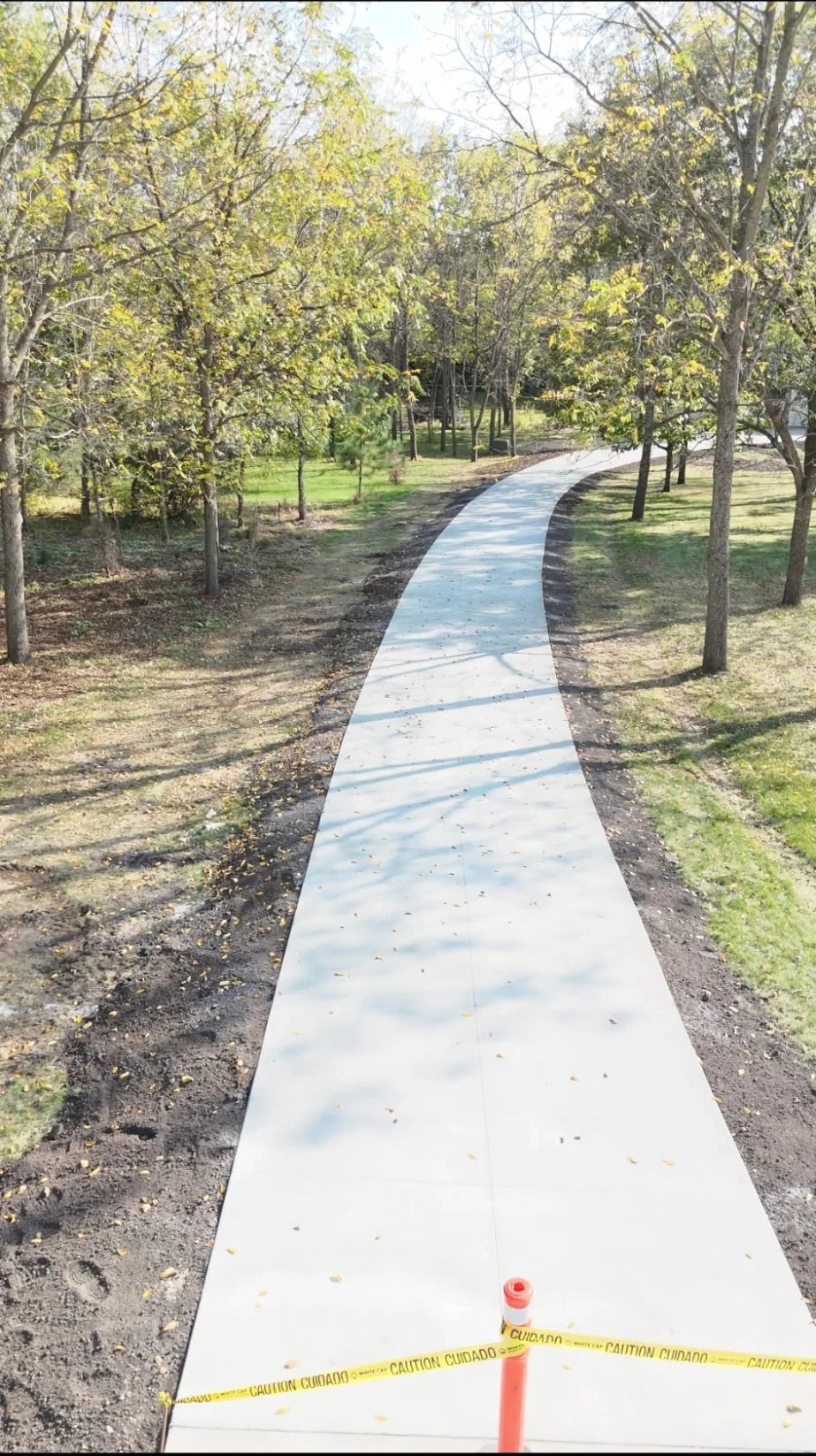
Park work has a problem street work does not: getting there. A trail segment three hundred feet into a park has no road to back a truck down, and the ground between the street and the pour is grass the department would rather we not destroy. Half of trail construction is figuring out how the concrete arrives without leaving ruts across the lawn.
Half of trail construction is figuring out how the concrete arrives without leaving ruts across the lawn.
Pouring Praises Custom Concrete builds park and trail concrete for parks and recreation departments throughout southeastern Minnesota. Multi-use path segments and connections, pavilion and picnic shelter slabs, restroom building pads, playground and fitness station pads, and the accessible routes that link them together.
Trails are also public accessibility infrastructure. A multi-use path is typically eight to ten feet wide and has to hold running slope and cross slope within accessible limits over long distances, across terrain that does not cooperate. Holding cross slope on a path following a hillside takes deliberate grading, not just a screed and good intentions.
Trail parameters
- Width
- 8 to 10 ft multi-use
- Thickness
- 5 to 6 in, more for maintenance vehicles
- Slope
- Held within accessible limits along the run
- Restoration
- Staging areas regraded and reseeded
Getting Park Concrete Right
Park projects are judged by people using them on a Saturday, so the finish and the routing matter as much as the structure.

Access Planned So the Park Survives It
Before we schedule a pour we work out how material reaches it, whether that is a buggy run, a pump, or staging plates across turf. Departments remember the contractor who left tracks across the ball field. We would rather spend the extra hour on access than spend a week on restoration.
Accessible Slopes Held Over Distance
On a multi-use path, running slope and cross slope have to stay within limits continuously, not on average. That means grading the subgrade deliberately along the whole run and checking as we go. Where terrain forces a steeper section, we build the landings and transitions the standards require rather than hoping nobody measures.
Finished for Wet Weather and Bare Feet
Trail and pool-adjacent surfaces get a broom finish oriented for traction and drainage, because these get used in the rain and often without shoes. Edges are tooled so they do not chip under bike and stroller traffic, and joints are placed where they will not catch a wheel.
How Park Projects Run
Walking the Route
We walk the trail alignment or the pad location with your parks staff, work out equipment access and staging, identify trees and roots that affect the route or need protection, and confirm the grade the path has to hold. Access and tree protection get settled here, before anything moves.
Subgrade and Base
Sod and topsoil are stripped along the alignment, unsuitable material removed, and aggregate base placed and compacted to the specified depth. Grade is set continuously along the run for both drainage and accessible slope limits, which on a trail means checking frequently rather than at the ends.
Forming and Placement
Forms follow the alignment including the curves, which is most of a trail. Reinforcement goes in where the detail calls for it, and pours are sequenced in manageable segments so placement and finishing stay ahead of the set even where access is awkward.
Finish, Joints, Cure, and Restoration
Broom finish for traction, joints cut on schedule, edges tooled, and proper cure with the segment protected from traffic. Then we restore what we disturbed getting there, regrade and reseed the staging areas and any turf damage, so the park goes back the way we found it.
Parks Departments Across the Region
We build park and trail concrete throughout Olmsted, Dodge, Goodhue, Steele, Wabasha, Fillmore, Mower, and Houston counties from our base in Rochester.
Trail segments, shelter slabs, and park pads for departments in Byron, Stewartville, Kasson, Dodge Center, Owatonna, Pine Island, Zumbrota, Plainview, Chatfield, Eyota, Lanesboro, Preston, and the surrounding communities.
View our full service area or contact us to confirm coverage.
Park and Trail Concrete: Common Questions
How wide and thick should a multi-use trail be?
Can you build a trail where trucks cannot reach?
How do you handle trees along a trail alignment?
Do trails need to meet accessibility standards?
Can you pour pavilion and shelter slabs?
When is the best time of year for park work?
Other Concrete We Pour
Municipal Concrete Municipal Sidewalk Replacement Walkway Construction ADA Ramps Basketball Courts
Trail or Park Project Coming Up?
Multi-use path segments, shelter and restroom pads, playground surfaces, and accessible park routes across southeastern Minnesota. Walk the site with us and we will work out the access and the number.
Questions? Call us directly: (507) 735-8820