Lake City Stamped Concrete
Stone-look slabs for bluff-town lots.
Stamped patios, entry walks and stepped walkways for Lake City homes above Lake Pepin. Slate and flagstone textures that suit an older river-town house, integral color mixed in the truck, and a sealing schedule built for what a Mississippi valley winter actually does to a slab.
Free Site Visit
Get a free site visit.
Written quote within a few days. No pressure, no upsell. The owner answers the phone.
How We Work It
Three things decide whether stamping holds up here.
01
Pattern Choice
Pick the texture against the house, not a catalog.
Lake City has a lot of older housing stock with real stone in the foundations and porches, so irregular slate and flagstone usually sit better than a tight, uniform pattern. We bring cured samples and hold them against your siding and steps in daylight before anybody picks anything.
02
The Stamp Window
Twenty to forty minutes, and the river changes it.
Concrete only takes an impression while it is firm but still soft. Humidity coming off Pepin and a breeze on an open bluff lot can move that window either direction, so we watch the slab, not the clock, and we staff the pour heavy enough to reach every foot of it in time.
03
Sealing
In a river valley the sealer is the whole job.
Fog, snowmelt and hard freeze cycles are rougher on a stamped surface here than a few miles inland. We seal about a week after the pour and put you on a roughly three-year re-coat. Skip that and the color goes chalky no matter how good the stamp was.
Recent Pours
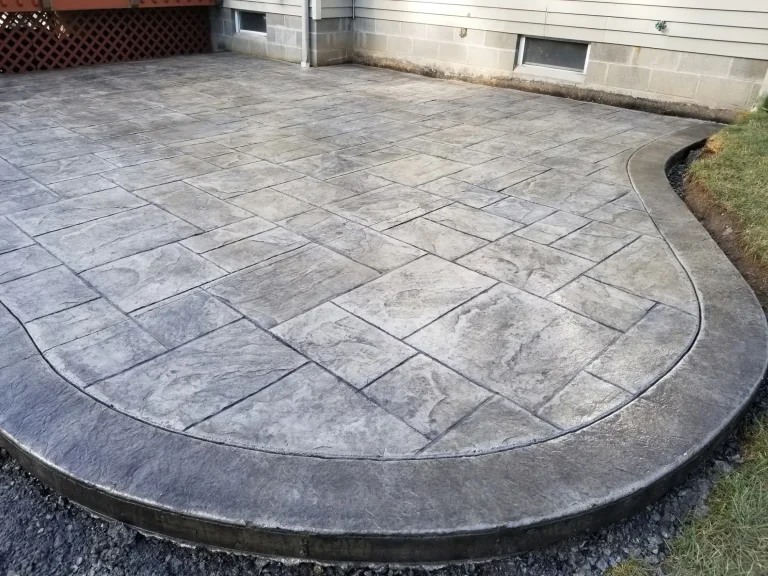
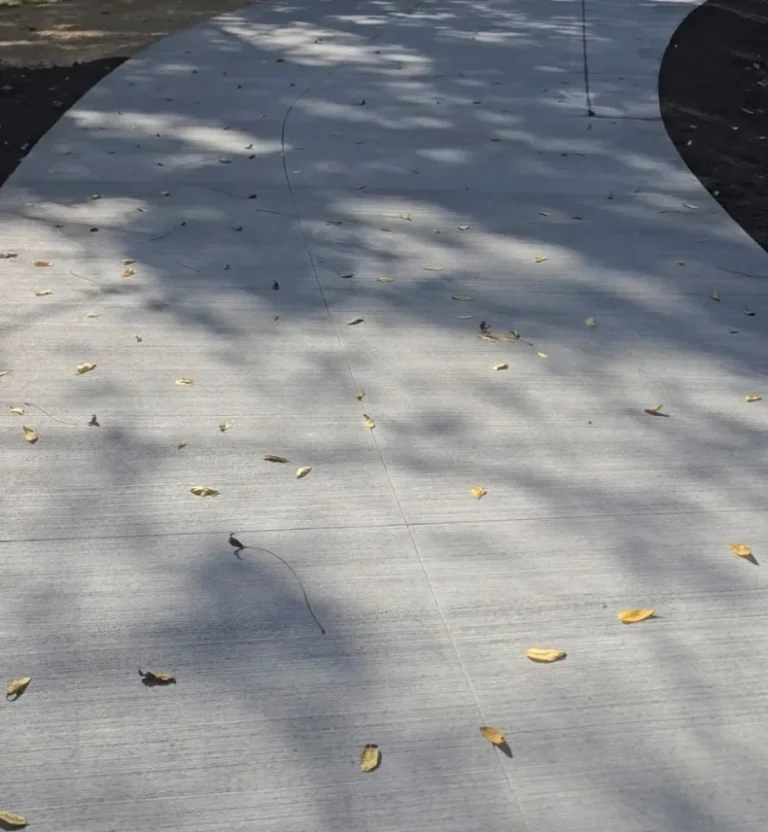
Work we’re proud to sign.



Questions We Get
What Lake City folks ask us.
Will the color fade sitting out in a river valley?
Integral color is mixed through the concrete, so it cannot wear off the way a surface stain can. What fades is the sealer, and around Pepin the damp and the freeze cycles work on it harder than they do inland. Kept on a three-year re-coat, a Lake City slab looks close to the day we finished it. Let the sealer go five or six years and it will look dull and chalky long before the concrete itself has any problem.
Which colors age well on a bluff lot?
Mid-range grays, warm tans and soft browns hold up best. They stay in the same family with limestone, weathered wood and whatever the light off the water is doing on a given afternoon. Very dark charcoals and strong reds look sharp on a sample but they show every bit of surface wear and any sealer flaw, and they can read heavy against an older river-town house. We steer people toward something a shade quieter than they first pick, and nobody has come back unhappy about that.
Is a stamped walkway too slick on a slope?
A smooth slate pattern under a glossy sealer can be, and a lot of Lake City yards run downhill toward the water. On any walk with real pitch we add a non-slip grit into the sealer and we lean toward a coarser texture like cobble or a rougher flagstone that has its own grip. We also step long runs with landings instead of pouring one continuous ramp, which is easier to walk in January and looks better besides.
Where does stamped concrete crack, and can you hide it?
Concrete moves, and in this climate it will relieve that stress somewhere. Our job is deciding where. We saw control joints within about twelve hours, cut along the natural grout lines of the pattern, so any relief crack lands inside a stone joint and reads as part of the design. Random cracking across the field of a slab almost always traces back to skipped joints, a thin base or no steel. We run half-inch rebar and four inches of compacted base under stamped work the same as any other pour.
How long before we can walk on it?
Foot traffic in a day or two, furniture after about a week, and we hold sealing until the slab has cured enough to take it. We leave you a written cure schedule so nobody has to guess.
Service Area
Up the river to Lake City.
The Long Version
Stone you pour in one piece.
Stamped concrete gives you the look of cut stone in a single reinforced slab. The concrete goes down, gets floated flat, and then while it is still workable we press textured mats into the surface so it takes on the pattern and grain of slate, flagstone or cobble. Color comes from two places: a pigment mixed into the load at the plant, which tints the concrete all the way through, and a release powder broadcast on top at stamping time that keeps the mats clean and settles a darker, weathered tone into the low points. That second layer is what makes the stones read as separate pieces instead of one flat sheet of gray.
Around Lake City, that is a good fit with the housing stock. A lot of the older homes here already have stone in the foundation, the porch piers or a retaining wall somewhere on the lot, and an irregular flagstone or slate pattern picks that language up without pretending to be something it is not. Newer places up on the bluff tend to want something cleaner. Either way we bring cured samples to the site and look at them where the slab will actually live, because a chip under shop lights and a hundred square feet cured in your own yard are two different things.
The pour itself is a timing job more than anything. There is a window of roughly twenty to forty minutes when the slab is firm enough to hold an impression and still soft enough to take one cleanly. Out here that window is not predictable from a forecast. Damp air off Pepin, a wind on an exposed lot, and full afternoon sun on a bluff all push it around, so we watch the concrete and we bring enough hands to reach the whole surface before any of it sets. A stamp pressed late is shallow and washed out, and no amount of sealer fixes that after the fact.
Under the pattern, the build is the same as anything else we pour. Four inches of compacted Class 5, grade set so water runs off instead of pooling where it can freeze, and half-inch rebar dead center in the slab. Control joints get saw-cut within about twelve hours, run along the grout lines of the stamp, so if the slab relieves stress it does it inside a stone joint. Sloped yards get particular attention here, because a walkway running down toward the water has to shed runoff at every step or it turns into a sheet of ice by December.
Then there is sealing, which in a river valley is not a finishing touch but the thing that decides how the slab looks in year five. We put a solvent-based acrylic down about a week after the pour and set you up for a re-coat around year three. Fog, snowmelt and repeated freeze and thaw are harder on a stamped surface here than a few miles inland, and the difference between a maintained slab and a neglected one is obvious from the driveway. Rochester is about forty minutes away, close enough that coming back to re-seal is a normal thing rather than a favor.
Stamped work is not right for everything, and we would rather say so up front. If a section may need to come up for a utility line, or sees heavy equipment traffic, a plain broom finish or a paver field is the smarter call. Adding on to an existing stamped patio means matching a slab that has weathered for years, which we can get close to but should talk through honestly first. If you want a wider look at the decorative options, our decorative concrete work in Lake City covers finishes beyond stamping, and most stamped jobs here start as concrete patios before anyone picks a pattern.
When you are ready, call and tell us what you are picturing. We drive up, walk the lot, look at how it drains, hold samples against the house, and hand you a free written quote with every line spelled out. Pedro is the one who shows up and the one who pours it. Reach us at (507) 735-8820, through the contact page, or start by looking at the gallery. Everything we pour in Lake City is insured and bonded, and we stand behind the workmanship.
Ready to Pour
Let’s put stone under your feet.
Free site visit, samples in hand, and a written quote with nothing buried in it. Serving Lake City and Wabasha County from Rochester.