Commercial Slab
Installation in
Rochester, MN
Reinforced, spec-grade flatwork for warehouses, retail pads, distribution centers, and industrial floors across Olmsted County. Insured and bonded. Owner answers the phone.
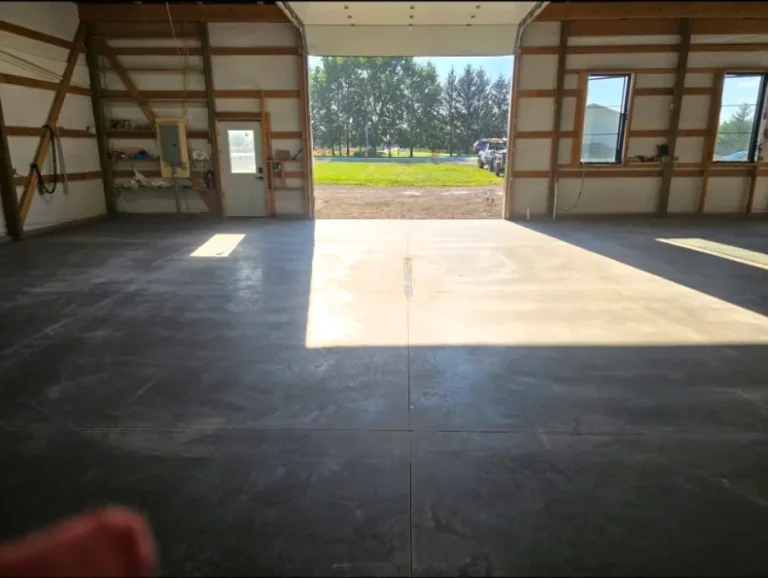
A commercial slab is not a residential driveway poured thicker. The design criteria are different: point loads from racking systems, forklift traffic patterns, drainage requirements dictated by health codes or OSHA, and flatness tolerances that prevent pallet-jack tire blowouts. Every commercial pour Pouring Praises takes on starts with a site evaluation and a conversation about how the slab will actually be used, because the right spec for a cold-storage warehouse floor is nothing like the right spec for a retail strip mall pad.
In southeastern Minnesota, the freeze-thaw cycle is the dominant stress on commercial concrete. Olmsted County sees between 100 and 130 freeze-thaw cycles per year, and that number rises on sites with variable drainage. Pouring Praises uses air-entrained concrete mixes designed for MN exposure categories, places control joints at intervals that match the slab’s thermal expansion coefficient, and applies curing compounds that maintain moisture during the critical first seven days when compressive strength development is most sensitive to temperature swings.
On commercial projects, timing matters in ways it does not on residential work. Concrete pours have to be coordinated around steel erection schedules, plumbing rough-in windows, and general contractor deadlines. Our crew has spent years working inside larger construction timelines and understands how to sequence a pour so it does not become the reason the project slips. We show up when we say we will, we pour clean, and we hand off a slab that the next trade can work on without complaints.
Why Pouring Praises
Four reasons Rochester businesses choose us.
Concrete is one of those trades where the difference between a crew that knows commercial work and one that does not shows up three years after the pour. Here is where the gap lives.
Spec-grade mixes, every time
We order what the job calls for. Not what is on the truck.
Commercial slabs in Minnesota require air-entrained concrete with the right water-cement ratio for freeze-thaw exposure. We spec every pour to ASTM C94 and Mn/DOT mix requirements, then verify the load ticket before a yard hits the forms. A residential crew ordering off habit instead of spec is how you get a warehouse floor that spalls in year two.
Owner-operated accountability
The person who quotes it is the person who pours it.
No project managers in the middle. When you call to ask a question about your slab, the operator who laid the forms answers. That direct line of accountability is what makes small issues stay small instead of becoming subcontractor finger-pointing at 30 days in.
Control joint placement that holds
Joints cut to depth, on schedule, not guessed.
Control joints that are too shallow crack randomly. Joints cut too late produce raveled edges. We saw-cut within six to twelve hours of finishing, one-quarter to one-third slab depth, on a grid sized to the slab’s thickness and the projected thermal range. Sawing is not an afterthought. It is part of the structural design.
How We Work
From site walk to finished floor.
Three phases. Each one builds on the last. None of them are skippable if you want a slab that performs under commercial load.
Site & Subgrade
Subgrade prep and form setting
Before a single yard of concrete arrives, we excavate to design depth, compact the subgrade to 95% Modified Proctor density, and install the base course. On commercial sites, we test for soft spots and add aggregate where the soil bearing capacity is borderline. Forms are set to grade with laser levels, not eyeball, so the finished surface slopes exactly where the drainage plan requires. Vapor barrier goes down last before steel.
Reinforcement & Pour
Steel placement and concrete placement
Rebar is positioned on chairs so it sits at the correct depth in the slab, not resting on the vapor barrier. We pour in sequences that minimize cold joints, work the concrete to full consolidation at the edges and around any embedded sleeves or anchors, and strike off to a consistent elevation before the bull-float pass. On larger pours, we coordinate multiple trucks to maintain continuous placement and avoid low-strength seams where loads will concentrate.
Finishing & Cure
Surface finish, saw-cutting, and curing
Finish texture depends on use: broom finish for exterior aprons and loading docks, power-troweled smooth for interior warehouse floors, medium broom for pedestrian traffic areas. Control joints are saw-cut to depth within the window the concrete opens up for it. Cure compound or wet cure blankets go on immediately after finishing is complete. We document surface flatness on large commercial pours and will provide the F-number readings if the project spec requires them.
Where We Work
Rochester, Olmsted County, and SE Minnesota
Pouring Praises runs commercial slab crews throughout Rochester and the surrounding Olmsted County area. We work regularly in Byron, Stewartville, and Kasson, and take commercial projects across the broader southeastern Minnesota corridor, including Dodge, Fillmore, Winona, and Goodhue counties.
Most of our commercial clients are in Rochester proper, where the steady pace of medical, industrial, and retail development keeps the pipeline full. If you are building outside that core, call us. We would rather tell you we cannot serve your site than have you find out at bid time.
Full service area map →Common Questions
What people ask before they call.
What does commercial slab installation cost in Rochester, MN?
Commercial slab pricing in Rochester typically runs between $8 and $16 per square foot installed, depending on slab thickness, reinforcement spec, site access, and surface finish. A basic 4-inch pad for a small commercial building will land near the lower end. An 8-inch industrial floor with troweled finish, embedded anchors, and tight flatness tolerances will land nearer the upper end or above it. The widest variable is subgrade condition: sites that need significant grading or aggregate import add cost that we cannot see until we walk the site. We provide written line-item quotes with no gray areas, so you know exactly what you are paying for before work starts.
How long does a commercial slab installation take?
A typical commercial pad pours in one to two days of active concrete work, but the total project timeline from mobilization to handoff is usually ten to fourteen days. That window includes subgrade prep and compaction testing, form setting, reinforcement, the pour itself, saw-cutting, and the minimum cure period before foot traffic is safe. Larger slabs with multiple pours or complex site conditions take proportionally longer. We schedule commercial projects as complete sequences, not day-by-day, so your general contractor can build the pour schedule into the overall project timeline from the start.
How durable is a commercial concrete slab in Minnesota winters?
A properly designed commercial slab should last thirty to fifty years in Minnesota conditions without structural degradation. The critical variables are mix design, air-entrainment percentage, water-cement ratio, and the curing period. We use mixes specifically designed for MN freeze-thaw exposure with 5 to 7 percent air entrainment, water-cement ratios below 0.45, and minimum 28-day cure periods before full load is applied. Slabs that fail early in Minnesota almost always trace back to one of three problems: mix design that was not specified for the climate, insufficient curing time before winter loading, or subgrade settlement from inadequate compaction at installation.
What maintenance does a commercial slab require?
Routine commercial slab maintenance is minimal when the original spec and installation were done correctly. The primary task is keeping control joints clean and filled: debris in a joint prevents it from opening and closing with thermal cycles, which transfers stress to the slab surface and produces random cracking. We recommend cleaning and resealing joints every three to five years depending on traffic volume. Exterior slabs benefit from a penetrating sealer applied every five to seven years to limit chloride intrusion from deicing salts. Interior warehouse floors may benefit from a hardener or densifier applied in the first year to reduce dusting and increase surface abrasion resistance, particularly under forklift traffic.
Do you handle commercial slab installation for new construction or only existing buildings?
Both. We work on new construction sites as a concrete subcontractor under a general contractor, and we work directly with property owners and developers on ground-up commercial pads. On new construction projects we coordinate directly with the GC on scheduling, embedded item placement, and handoff documentation. On direct owner projects we manage the subgrade and base work ourselves or coordinate with a grading sub. If you have an existing building that needs a floor replacement, a slab addition, or a thickened edge for new equipment loading, we can evaluate the existing conditions and quote the scope. Most of our commercial clients come back for multiple projects once they have worked with us the first time.
Ready to Pour
Let’s get your slab spec’d.
Free site visit. Written quote, line by line. Rochester, Olmsted County, and across SE Minnesota. Call or fill out the form and we will be in touch within one business day.
Insured & Bonded · Owner-Operated · See Our Work → · Contact Us →