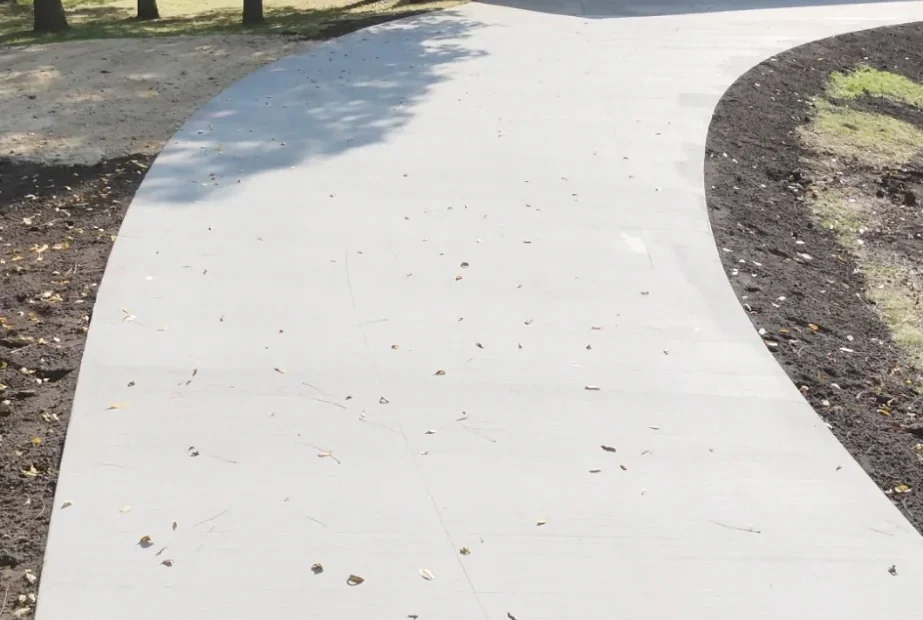
Bluff-side driveways in Red Wing fail from water, not from the slope itself. When a drive runs up a grade, spring melt and rain want to sheet straight down it and pool against the garage, and that standing water is what freezes and heaves the slab. The fix is grading the fall so water leaves the drive, holding the edges so runoff cannot undercut them, and building the part you never see correctly: four inches of compacted Class 5 base and half-inch rebar centered in the pour. Get the water off it and a Red Wing driveway lasts twenty-five years on a slope just as well as it does on flat ground.
Red Wing is not a flat town. It climbs off the Mississippi into the bluffs, and a good share of the driveways here run up a grade to a garage tucked below or beside the house. Homeowners on those lots often assume the slope is the enemy, that a driveway on a hill is doomed to crack and there is not much to be done about it. That is not true. A bluff-side driveway that is graded, drained, and based correctly lasts every bit as long as one on flat ground. The ones that fail early fail because of water, and water on a slope is a solvable problem. This post walks through why these driveways crack and what actually keeps them alive through a Red Wing winter.
Why the Slope Gets Blamed, and Why Water Is the Real Culprit
When a driveway on a grade cracks, the slope gets the blame because it is the obvious difference from a flat lot. But concrete does not care much about angle. It cracks when the ground underneath it moves, and the thing that moves ground in Red Wing is the freeze-thaw cycle acting on trapped water. On a slope, water behaves differently than it does on the flat: melt and rain sheet down the drive at speed, and wherever that water slows and pools, usually at the bottom against the garage slab or in a low spot where the grade flattens, it soaks into the base and sits. When it freezes, it expands, and it lifts the concrete above it. Do that a few dozen times over a winter and a spring, and the slab cracks and heaves.
So the real question on a bluff-side Red Wing driveway is never how do we fight the slope. It is where does the water go, and how do we make sure it never sits under or against the concrete. Answer that and the slope becomes a non-issue.
Grading the Fall So Water Leaves the Drive
The first tool is the grade itself. On a sloped drive we set the cross-pitch and the layout so water is carried off the surface to the side, into a swale or toward the street, instead of being allowed to run the full length and pile up at the bottom. Sometimes that means crowning the drive slightly so water sheds to both edges; sometimes it means pitching the whole surface to one side where a swale can carry it away. On a steep Red Wing lot we may step the driveway, breaking a long run into levels so no single stretch builds up a destructive head of water, and so the transitions can be graded to shed rather than collect.
Where the drive meets the garage at the bottom, we pitch the last few feet to move water away from the slab and the foundation, not toward it. That bottom transition is where most failed bluff-side driveways in Red Wing let go first, because that is where the water was allowed to pool.
Holding the Edges So Runoff Cannot Undercut
On a slope, water does not just sit, it moves, and moving water erodes. If the edges of a driveway are not held, runoff coming off the drive or the yard above it can wash the base out from under the slab edge over a few seasons, and once the base is gone the concrete has nothing to sit on and cracks. We form the edges of a bluff-side drive with a thickened perimeter, so the slab is deeper and stronger where it meets the open ground, and we grade the adjacent yard so runoff is directed away from the driveway edge rather than across it. On the steepest lots we will add a hard edge or a curb detail where the situation calls for it, to keep runoff channeled and the base intact.
The Base: Compacted Class 5, Not Whatever Was There
None of the water management matters if the base is bad, because the base is what actually carries the slab. On every Red Wing driveway, sloped or flat, we strip the topsoil down to firm ground, then compact four inches of Class 5 aggregate in lifts. On a slope this takes more care, not less, because the base has to be built and compacted along the grade without leaving soft spots that will settle later. A properly compacted base drains, resists frost movement, and gives the slab a stable, uniform bed. The thin, poorly compacted base under most of the old driveways we tear out is exactly why they failed, and on a bluff lot a bad base is even less forgiving.
Half-Inch Rebar, Centered, Every Time
Reinforcement is what holds a driveway together as a single piece when the ground does try to move, and this is where the biggest difference between a lasting drive and a failing one hides. We use half-inch steel rebar on sixteen-inch centers, set on chairs so it rides dead-center in the slab. That center position is where freeze-thaw tensile stress actually pulls the concrete apart, so that is where the steel needs to be. Wire mesh, which is under most of the old Red Wing driveways we replace, floats to the bottom of a wet pour and ends up doing almost nothing. On a slope, where the loads and the water stress are already working harder on the slab, real rebar in the right place is not optional.
Joints Cut on Time, Cured Right
Once the slab is poured and finished, we saw-cut the control joints within twelve hours so the concrete cracks on the lines we set rather than randomly across the driveway. On a stepped or sloped drive the joint layout matters even more, because the joints have to work with the levels and the direction of the pour. We cure the slab properly, under tarp when the weather demands it, so it gains strength before the first freeze rather than getting hit by cold while it is still green. A driveway that is cut and cured right on a Red Wing slope will crack only where we told it to, in the joints, where you will barely notice.
What a Bluff-Side Driveway Should Cost You Over Its Life
A driveway built this way on a Red Wing slope costs more up front than a thin slab on a skipped base with wire mesh. It also lasts twenty-five to forty years instead of eight or ten, which makes it the cheaper driveway by a wide margin when you count the price per year of service. The bluff-side drives we get called to tear out are almost never victims of the slope. They are victims of a contractor who poured flat, skipped the drainage, thinned the base, and used mesh instead of steel. Do the opposite of all four and the hill stops mattering. If you have a sloped driveway in Red Wing that is cracking, or you are planning a new one on a bluff lot, have us out for a free look at your Red Wing project and a written quote. We also handle concrete driveways across Red Wing on every kind of lot, flat or steep. Call us at (507) 735-8820 and we will walk it with you.
Red Wing Bluff-Side Driveway FAQ
Is a driveway on a Red Wing slope more likely to crack?
Only if it is built wrong. The slope itself does not crack concrete; trapped water freezing under the slab does. A sloped drive that is graded to shed water, edged to resist runoff, and poured on a compacted base with centered rebar lasts just as long as one on flat ground. The bluff-side driveways that fail early almost always had the drainage skipped and the base thinned.
How do you keep water from pooling at the bottom of my sloped drive?
We set the grade so water sheds to the side or the street on the way down rather than running the full length and piling up at the garage, and we pitch the last few feet at the bottom to move water away from the foundation. On steep lots we may step the driveway into levels so no single stretch builds up a damaging head of water.
Do you have to step a driveway on a steep Red Wing lot?
Not always. Many sloped drives pour as a single graded surface. We step a driveway when the grade is steep enough that a continuous slope would be hard to use or would concentrate too much water at the bottom. When we do step it, each level is graded to shed water and the transitions are formed and cut to work with the slope.
Why does the base matter more on a slope?
Because a slope gives water more energy to erode and more ways to move under the slab, so a soft or thin base washes out and settles faster than it would on flat ground. We compact four inches of Class 5 in lifts down to firm soil, built carefully along the grade so there are no soft spots. A stable base is what keeps a bluff-side slab from settling and cracking.
Can you fix my existing cracked bluff-side driveway?
If the slab is heaved or cracked through, the honest fix is a full tear-out and replacement, because the failure is almost always in the base and the drainage underneath, not just the surface. We break it out, rebuild the base and the grade correctly, and pour a new slab with real rebar. Come out for a free look and we will tell you straight whether a repair or a replacement is the right call.
Free Look at Your Red Wing Bluff-Side Driveway
We walk your slope, read the drainage, and hand you a written quote with grade, base, steel, concrete, and edging all broken out. No pressure, no obligation.
Book a Site Visit (507) 735-8820Red Wing concrete driveways · Red Wing, MN · Goodhue County · Get a quote