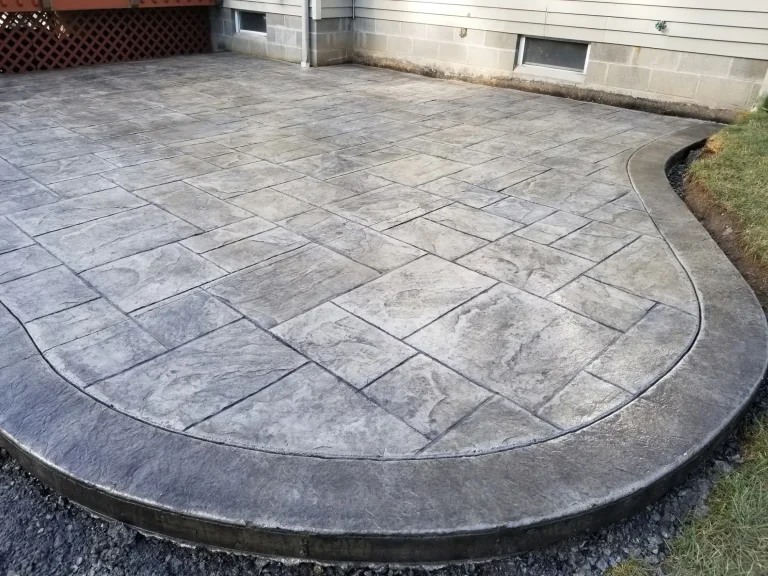
A stamped patio in Red Wing earns its keep when it is built to catch the river-valley view and to survive the freeze-thaw underneath. That means terracing the patio down a bluff-side yard so each level sits where the view is best, grading every pad to shed water away from the house, and pouring the whole thing over a compacted base with half-inch rebar so it does not heave. The stamp and color go on top, matched to your home, and a seal locks the look against road salt and melt. Done right, it is a stone-looking outdoor room that holds up for decades.
Red Wing yards have something most yards do not: a view. The town rises off the Mississippi into the bluffs, so a lot of backyards here look out over the river valley, over Barn Bluff, over the rooftops of the old downtown. A stamped concrete patio is one of the best ways to turn that view into a place you actually use, because it gives you the warmth and character of stone at a fraction of the cost and it can be shaped and terraced to fit a sloped yard in a way a deck or a paver patio cannot. This post walks through how we build a stamped patio in Red Wing to make the most of the view and to survive the winters that come with living on a river.
Start With the View, Then the Levels
The first thing we do on a Red Wing patio job is stand in the yard and figure out where you will actually sit. On a bluff-side lot the best view is often part way down the slope, not right off the back door, so a single flat pad at the house misses the point. We lay the patio out in terraces, stepping it down the grade so one level catches the river view, another sits closer to the house for the grill and the door, and steps or a short wall tie them together. Getting the levels right is a design conversation as much as a concrete one, and it is worth taking the time up front because the terracing is what makes a sloped-yard patio feel like an outdoor room instead of a slab stuck on a hill.
Every Pad Graded to Shed Water
Terracing a patio down a Red Wing slope means each level has to be graded on its own to move water off it and away from the house. We pitch a quarter-inch of fall per foot on every pad so rain and melt run off the surface, and we set the transitions between levels so water is carried down and out to a swale rather than allowed to sheet from one pad onto the next and pool. On the wetter valley-floor lots near the water, where the ground drains slowly and the water table rides close to the surface, we will add a drain at the high side of the patio so the whole system is working with the water instead of against it. Standing water is what freezes and lifts concrete, so getting the fall right on every level is not a detail, it is the whole ballgame for a patio that lasts.
The Base and Steel That Keep It From Heaving
The finish is what you see, but the base and the reinforcement are what keep a stamped patio alive through twenty Red Wing winters. Under every pad we strip the topsoil to firm ground, compact four inches of Class 5 aggregate in lifts, and set the grade with a laser so the surface pitches exactly where we want it. Then we tie in half-inch rebar on chairs so the steel rides dead-center in the slab, right where freeze-thaw tensile stress wants to crack it. On a terraced patio this work happens on every level, because a beautiful stamped surface on a pad that heaves is still a failed pad. Wire mesh, the cheap option, floats to the bottom during the pour and does nothing, which is exactly why so many older patios we replace failed.
Matching the Stamp to Your Red Wing Home
Red Wing is a town of real architectural character, and a stamped patio should look like it belongs to the house it is attached to. We stamp slate, ashlar, flagstone, cobble, and wood-plank patterns, and the right one depends on the home. An older house in the historic neighborhoods or up around the Pottery District usually wants a softer, irregular flagstone or a cobble that echoes the brick and stonework already on the property. A newer build up on the bluff edges carries a cleaner ashlar or plank pattern well. We bring cured samples out and hold them against your brick and trim so the choice is grounded in your actual home, not a catalog, and then we pour a sample board mid-project so you approve the color cured in your own daylight before the full patio goes down.
Timing the Stamp So It Reads Like Stone
What separates a stamped patio that looks like real stone from one that looks like a rubber mat pressed into mud is timing. Concrete is only stampable for a window of about twenty to forty minutes, while it is firm enough to hold the impression but soft enough to take it cleanly. That window shifts with the temperature and the humidity, so on a Red Wing patio we schedule the pour around the weather and put enough hands on the job to stamp the whole surface while it is in the window. On a big terraced patio that can mean running two crews so no part of the pour sets before we reach it. The color comes in two layers: integral color mixed through the slab for a permanent base tone, and a release powder broadcast at stamping for the antique shading between the stones that gives the pattern real depth.
Sealing It Against the Salt and Melt
The seal is what keeps a stamped patio looking new through a Red Wing winter. Road salt, snow-melt, and UV fade unsealed stamping fast and pack grit into the joint lines, so about a week after the pour we put down a solvent-based acrylic sealer, and we refresh it around year three. On a patio that ices up we add a non-slip additive so the surface stays safe underfoot. Being the largest town we serve to the north, Red Wing is a regular stop for us, which means we are back through often enough to keep the sealer fresh and the color holding over the long run. A sealed, integral-colored, properly based stamped patio is a twenty-year surface, not a two-year one.
Putting It Together
A stamped patio built this way in Red Wing gives you the best of both things: a stone-looking outdoor room shaped to catch the river view, and a slab engineered to survive the freeze-thaw that comes with living on the Mississippi. It costs more than a flat pad thrown down without a base or a plan, and it lasts decades longer, which makes it the better spend. If you have a Red Wing yard with a view worth building for, have us out for a free look at your Red Wing patio and a written quote. We handle stamped concrete across Red Wing along with plain and finished patios of every kind. Call us at (507) 735-8820 and we will walk the yard with you.
Red Wing Stamped Patio FAQ
Can you build a stamped patio on my sloped Red Wing yard?
Yes, and a sloped yard is where a terraced stamped patio shines. We step the patio down the grade so one level catches the river view and another sits close to the house, grade each pad to shed water, and tie the levels together with steps or a short wall. The base and steel spec stay the same on every level so the whole thing holds up.
Will a stamped patio survive Red Wing winters?
It does when it is built and sealed right. Under the stamp is the same compacted base, half-inch rebar, and on-time joints as any pour we do, so the slab survives the freeze-thaw. On top, a solvent-based sealer goes down about a week after the pour and gets refreshed around year three to hold the color against salt and melt.
How do you match the stamp pattern to my home?
We bring cured samples out and hold them against your brick and trim, because Red Wing homes have real character and the finish should look like it belongs. Older homes usually suit a softer flagstone or cobble; newer builds carry a cleaner ashlar or plank. We also pour a sample board mid-project so you approve the actual cured color in your own daylight.
Is stamped concrete cheaper than a paver or stone patio?
Generally, yes, and it avoids the settling joints and weed growth that come with pavers and natural stone set in sand. Stamped concrete gives you the look of stone as one continuous slab, so there are no joints to shift and no gaps for weeds. We give you a written itemized quote after a free site visit so you can compare it honestly.
How long does a stamped patio take to build?
A straightforward stamped patio is often a few days: excavate and form, pour and stamp, then cut the joints and later seal it. A terraced bluff-side patio with multiple levels takes longer because of the forming and the grading on each pad. We lay out the schedule for you at the site visit so you know what to expect.
Free Look at Your Red Wing Stamped Patio
We walk your yard, find the view, and hand you a written quote with base, steel, stamp, color, and sealer all broken out. No pressure, no obligation.
Book a Site Visit (507) 735-8820Red Wing stamped concrete · Red Wing patios · Red Wing, MN · Get a quote