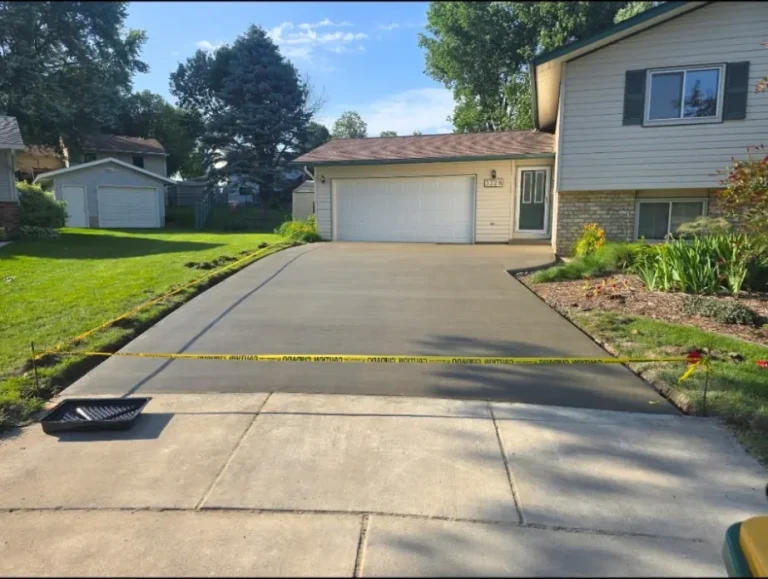
A driveway that falls toward the house is fine on its own. Plenty of lots sit below the street, and the drive has to get down there somehow. Trouble starts when nobody decides where the water goes once it reaches the bottom. Pitch, crown, the garage transition and the apron at the curb all have to be planned together, before a single form goes in.
Pedro can usually tell how a driveway was poured by standing at the garage door after a hard rain. If a sheet of water is sitting against the weatherstrip, somebody set the slab to grade and stopped thinking there. On a lot that sits above the road, gravity forgives a lot. On the many newer lots around Byron that sit lower than the street, gravity is working against you, and every drop that lands on the drive, plus whatever runs off the road, heads straight for the one door you use every day.
Water Follows the Concrete Unless Somebody Tells It Otherwise
No outdoor slab that was poured right is truly flat. Every one gets some fall so water keeps moving, and the only real decision is direction. On an uphill drive the easy answer is toward the street. On a downhill drive that answer would ask water to climb, which it will not do, so the plan has to send it sideways as it comes down.
That means shaping the slab so it sheds to one or both edges along its length, then making sure the ground beside those edges carries the water away. A drive that sheds neatly into the side yard is only half finished if the side yard tips back toward the foundation. On the walk we look at the whole lot, the rectangle being poured and everything around it, because the slab and the yard behave as one drainage system whether anyone planned them that way or not. Byron has a lot of recently graded lots where the finish grade around the house is still settling in, and that changes where runoff ends up.
Crown, Cross Slope, and Where the Low Line Lands
There are two common ways to move water off a sloped drive. A crown puts a gentle high line down the middle so water splits and runs off both edges. A cross slope tips the entire slab one way so everything leaves on a single side. Which one fits depends on what sits beside the concrete. Lawn on both sides that drains away from the house suits a crown. A property line or a foundation wall on one side means everything should head the other way.
The pitch has to be enough to move water and gentle enough that the drive still feels level when you step out of the car. Swing a car door open on a slab tipped too far and you will feel the balance is off. On a downhill drive we watch the low end hardest. The final few feet before the garage are where water slows down, and anywhere it slows down is where it starts to sit and soak in.
The Last Few Feet Before the Garage Door
The meeting point between the driveway and the garage slab decides whether the whole job works. The garage floor belongs to the house and rests on the house’s footings. The driveway floats on its own base. They need an isolation joint between them so the drive can rise and settle with the seasons without shoving the garage slab, and that joint has to stay sealed so it never becomes a funnel straight down into the soil under the garage.
The bigger move is finishing the driveway a touch lower than the garage floor, with the last stretch turned so it falls away from the door. On a low lot that sometimes means the drive levels out and reverses slightly just before the house, a shallow rise that water cannot get over. It takes careful forming and a crew that checks the elevations twice. It also keeps the garage dry through every spring melt.
Why a low spot at the door turns into a winter problem
Water that ponds at the door freezes there. It ices the exact spot you cross with groceries, it works into the joint, and it soaks the base right next to the house, where repeated freezing can lift the drive just enough to catch the bottom panel of the garage door.
Trench Drains: When They Earn Their Place
On a steep downhill drive somebody always brings up a trench drain, the long grated channel set into the concrete across the width of the driveway. Sometimes it is the right call. If the lot sits so low that the slab cannot be shaped to move water past the garage, a trench drain catches what the slope delivers and carries it off.
Carries it where is the part that gets skipped. A trench drain is only as good as the place its pipe empties, and that place has to be lower still, a daylight outlet down the yard or a proper connection. In Minnesota the pipe also has to be laid so it drains completely and does not hold water that freezes solid in January. A drain that backs up becomes an ice trough in front of the door. It needs leaves and grit cleared out now and then, too.
So our first move is shaping the slab well enough that a drain is never needed. When the grade honestly leaves no other choice, we put one in and show you where every bit of that water ends up.
The Street End Deserves the Same Attention
At the top of a downhill drive the apron meets the road, and on a lot below street level that apron is the first thing street water reaches. If it tips toward the house, every rainstorm and every plow pile melting at the curb sends water down your driveway before a drop has fallen on the drive itself. Shaping the top so street water stays in the street is half the work on these lots.
That top section also takes the most abuse: plow blades, tires turning in tight, and salt dragged off the road all winter. It gets the same base work and finishing as the rest of the slab, never a quick patch to tie into the curb. When Pedro walks one of these lots he starts at the curb with a level and works his way down to the garage door, and the way we build the whole approach is laid out on our page for concrete driveways around Byron. If the low side of the lot also holds a back patio, the same water has to be planned around out there, which is why we usually look at both on one visit.
Downhill Driveways: Questions We Hear
Is a driveway that slopes toward the house always going to have water trouble?
No. A downhill drive works fine when the slab is shaped to move water to the sides and the last stretch falls away from the garage. Problems come from drives poured to follow the dirt with no plan for the bottom. The slope itself is just a condition of the lot, and it can be designed around.
Can water at my garage door be fixed without replacing the whole drive?
Sometimes. If the trouble is a downspout, a yard that tips the wrong way, or a failed joint at the garage, those can be corrected on their own. If the slab itself funnels water to the door, the low section usually has to come out and be repoured with the right fall. We will tell you which one you have.
Does a trench drain freeze up in the winter?
One that is laid right should not, because it drains completely and holds no standing water. Drains freeze when the pipe has a sag, when the outlet gets buried in snow or ice, or when debris clogs the grate. A drain with nowhere lower to send water will freeze every time, which is why we sort out the outlet first.
Should my driveway sit higher or lower than the garage floor?
Slightly lower, with the final few feet turning water away from the door. A driveway that meets the garage dead level, or a little above it, pushes runoff and meltwater straight under the door. The two slabs should also be separated by a sealed isolation joint so the driveway can move without pushing on the garage.
Why does the top of my driveway near the street wear out first?
It takes the plow, the turning tires and the salt coming off the road, and on a low lot it also catches street runoff. If the base under that section was thin or it holds water, it fails sooner than the rest. Building it with the same care as the main slab is what keeps it from becoming the weak link.
Start at the Curb and Finish at the Garage Door
We will check the slope, the garage transition and the street end, then put the plan for your water and the price in writing.
Walk the Site With Us (507) 735-8820