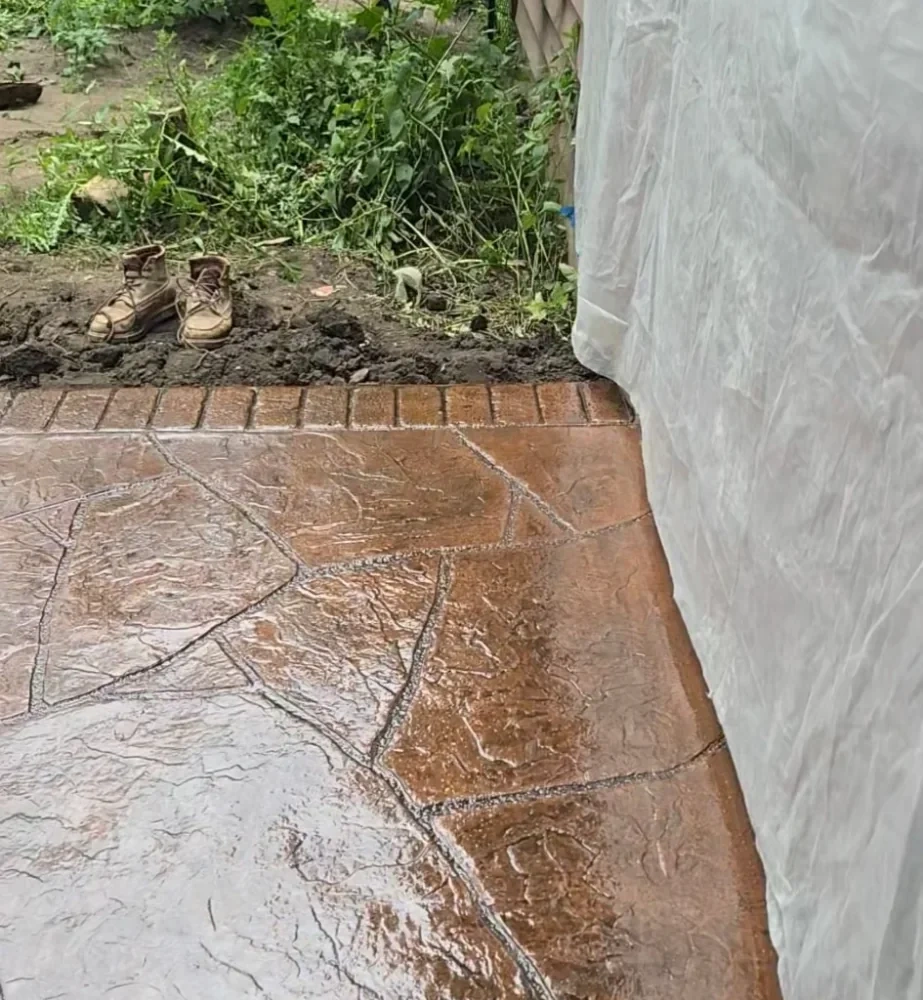
A concrete pour runs on a tight clock from prep to saw-cut. We walk the forms and steel one last time at 7 AM, run a slump test when the truck arrives around 8:30 and start placing, screed and float and edge by mid-morning, finish with a broom or stamp by early afternoon, and saw-cut the control joints that evening, 4 to 12 hours after placement. Concrete does not wait, so each step has a window, and missing a window shows up in the finished slab.
7:00 AM: The Last Walk Before Anything Is Locked In
Before the first truck rolls, we walk the whole job one more time. Forms get checked for grade and that they are staked solid enough not to blow out under the weight of wet concrete. The rebar gets checked that it is still up on chairs and tied where it should be, because foot traffic during setup can knock steel around. The base gets a final look. This is the last moment everything is still adjustable. Once concrete is coming out of the truck, the forms and the steel are where they are, so the walk-through exists to catch anything that moved or got missed before it gets buried for good.
8:30 AM: Slump Test, Then Placement Begins
When the truck arrives, the first thing that happens is a slump test, before any concrete goes into the forms. We fill a cone, pull it, and measure how far the concrete slumps down. That number tells us the consistency of the mix. A typical exterior flatwork slump runs around 4 to 5 inches. The slump test is the checkpoint that keeps the load honest, and the next section explains what happens when the number is wrong.
Once the slump checks out, placement starts. On a standard residential pour we run a crew of five: two on the chute guiding concrete out of the truck and moving it into place, one running the screed, one on the edges, and one working the grade and helping rake concrete to where it needs to be. Everyone has a job and the work moves continuously, because concrete starts setting the moment it leaves the truck and the crew is racing that clock all day.
10:00 AM: Screed, Bull-Float, Edge, and Rough Joints
As concrete fills the forms, the screed pulls across the top to bring it to grade and level. We use a vibrating screed on most flatwork, which does two jobs at once: it strikes off the surface to the right height and the vibration consolidates the concrete, driving out trapped air pockets and settling the mix tight around the rebar. A hand screed levels the surface but does not consolidate the same way, so the vibrating screed gives a denser, more durable slab. The difference matters most at the surface, where density determines how the slab stands up to freeze-thaw.
Right after the screed comes the bull-float. The crew runs a wide float across the surface to flatten the ridges the screed leaves and, more importantly, to bring the cream up. The cream is the fine paste of cement and water that rises to the top, and the bull-float pass works it up and closes the small surface voids. A good bull-float pass is what sets up a tight, durable finished surface. Then the edges get tooled with an edging tool to round and compact the slab edges, which are the most vulnerable to chipping, and we groove in rough control joints as a guide for the saw cuts that come later.
1:00 PM: Broom Finish or Stamping
The finish happens once the surface has firmed up enough to take it, and the timing here is everything, which the bleed-water section covers. For most driveways and walks, we pull a broom across the surface to create the fine texture that gives traction on a wet or icy Minnesota surface. The broom finish is simple, durable, and the right call for the vast majority of exterior flatwork.
A stamped pour is a different animal from this point on. Stamping has to happen in a fast window while the concrete is still soft enough to take the impression but firm enough to hold it, and that window is short. On a stamp job, after the surface is floated, the crew applies a release agent so the stamp mats do not stick, then presses the pattern mats into the surface in sequence, working fast across the whole slab before any of it sets too hard. Texture rollers and touch-up tools clean up the edges and any spots the mats miss. A broom finish is one pass with a broom. A stamp is a choreographed sprint against the set time, and there is no second chance once the concrete firms up.
How the Crew Knows When to Finish: Bleed Water
The single most important timing judgment of the day is when to start finishing, and the crew reads it off the bleed water. After placement, water rises to the surface as the concrete settles. That sheen of water has to come up and then evaporate before you do the final finishing. Finish too early, while bleed water is still on the surface, and you work that water back down into the slab, weakening the top layer and setting up scaling later. Wait too long and the concrete is too hard to take the finish cleanly.
The crew watches the surface and tests it. When the bleed water sheen is gone and the concrete will hold a footprint maybe a quarter inch deep without it filling back with water, it is ready for the broom or the stamp. This is feel and experience, not a number on a clock, and it shifts with the weather, which is the next piece.
How Temperature Moves the Whole Schedule
The times in this sequence are a normal day. A hot, dry, windy day compresses everything. Heat speeds the chemical set, and wind and sun pull the bleed water off fast, so the whole schedule slides earlier and the crew has less margin. On a hot pour we may be brooming hours sooner, and a stamp job gets genuinely tense because the window to press the pattern shrinks. We sometimes use a retarder in the mix or work in smaller sections on a hot day to keep from getting caught behind the set.
A cool, overcast day does the opposite. The set slows down, the bleed water lingers, and the finishing window pushes later into the afternoon and evening. The saw-cutting that might happen at 6 PM on a warm day might not be ready until 10 or 11 PM on a cool one. We plan pour days around the forecast for exactly this reason, because temperature is not a detail, it is the thing that sets the entire day’s clock.
6:00 PM to Midnight: The Saw-Cut Return
Control joints get their final saw cut 4 to 12 hours after placement, which on a morning pour means that evening or late into the night. The cut creates a planned weak line so that the slab cracks where we want it to, down in the joint, instead of randomly across the surface. Time it too early and the saw ravels the edges of the cut because the concrete is still too green. Time it too late and the slab may already be cracking on its own before the joint is in. The crew judges the return by feel and by test cuts, scoring a short test line and watching whether the edges hold clean, then adjusting based on the mix and how warm the day was. On a warm day the cut might be ready at 6 PM. On a cool one it could be 11 PM or later. We come back and do it when the slab tells us it is ready, even if that is well after dark.
What the Homeowner Should and Should Not Do
On pour day, the best thing you can do is stay out of the work area and let the crew run their clock. Do not walk on the fresh concrete, and keep kids and pets and tire tracks off it. Ask your questions before the pour or after the finishing is done, not during placement, because the crew is racing the set and cannot stop to talk through every step in the middle of it. Keep the access clear for the truck. After we leave, keep traffic off the slab, foot traffic for a day or two and vehicle traffic for a week, and longer in cold weather. We will give you the specific timeline for your slab before we go.
What to Ask About a Contractor’s Pour-Day Sequence
If you want to know whether a contractor runs a tight pour, ask them to walk you through their day. Ask whether they slump-test every load. Ask whether they use a vibrating screed. Ask how they decide when to start finishing, and listen for an answer about bleed water rather than a fixed time. Ask when they saw-cut and how they judge the timing. A crew that has poured thousands of yards answers all of that plainly, because it is just how the day goes for them. We pour across Olmsted, Dodge, and Steele counties, and we are happy to walk you through exactly how your pour day will run before we set a date.