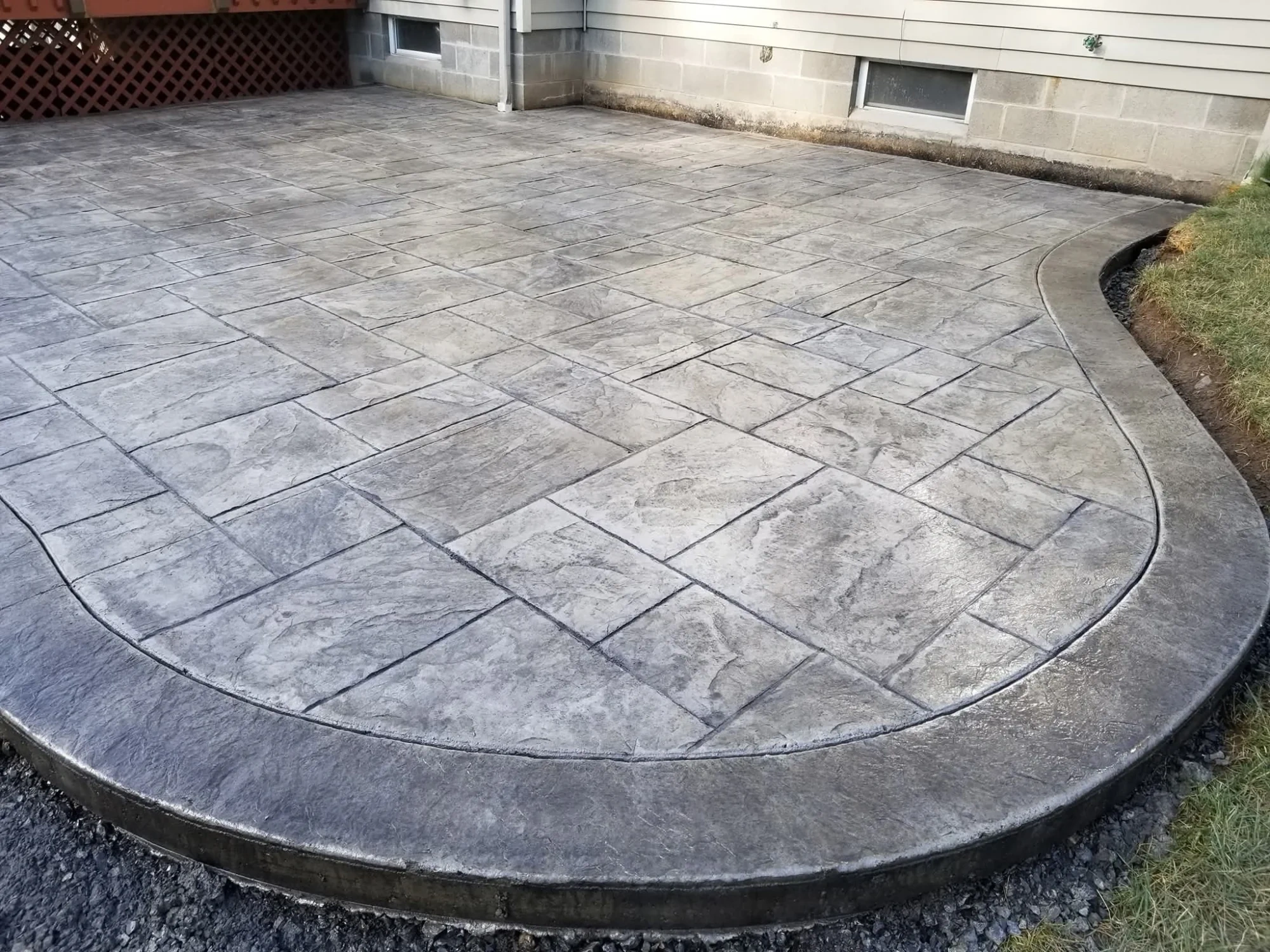
The most popular stamp patterns are slate, ashlar stone, flagstone, wood-plank, European fan, and cobble. Slate and ashlar suit patios and walkways, cobble and flagstone read well on driveways and entries, and wood-plank works where you want a deck look that lasts. Underneath the pattern, stamped concrete is engineered exactly like plain concrete: same base, same rebar, same control joints, same cure. The stamp is the finish, not a shortcut.
Matching the Pattern to the Application
Pattern choice is partly taste and partly fit. Slate and ashlar stone are clean, repeating patterns with defined joint lines, which makes them a strong fit for patios, walkways, and pool decks where you want an even, structured surface that feels finished. Flagstone is more irregular, with broken, natural-looking shapes, and it reads beautifully on entries, walkways, and patios where you want a softer, less uniform look. Cobble, with its tight repeating stone pattern, has the visual weight to carry a driveway or a courtyard apron, where a finer pattern would get lost under the scale of the space and under vehicle traffic. Wood-plank stamping mimics planking and shines on patios and porch surfaces where a customer wants the warmth of a deck without the rot, staining, and yearly upkeep that real wood demands in a Minnesota climate. European fan is a decorative radiating pattern that does well as a feature, a courtyard center or an entry, more than as a whole-driveway field.
There is real texture variation inside each family, too. Slate stamps range from a fine, tight grain to a heavier, more rugged texture. Flagstone can be tight-jointed or loose and rustic. The pattern name is the starting point; the specific stamp tools and the depth of the texture are where the look gets dialed in. We bring the actual stamps and color samples to the walkthrough so you are choosing from real surfaces, not a brochure photo.
Integral Color Versus Broadcast Release: Two Different Jobs
Color on stamped concrete comes from two systems, and they do different things. Integral color is pigment mixed into the concrete itself before it is poured, so the color runs all the way through the slab, not just on the surface. A broadcast or surface-applied color hardener and a release agent add the secondary tones and the antiqued, multi-tone look that makes stamped concrete read like real stone instead of a single flat color. Most quality stamped work uses both: integral color for the base body of the slab and a release agent on the surface for depth and contrast in the pattern.
The reason this matters over time, especially here, is wear. A surface-only color sits in the top layer of the concrete. As that surface wears, abrades from traffic, and takes freeze-thaw and de-icer exposure over fifteen Minnesota winters, surface-only color fades and thins where the wear is heaviest. Integral color does not have that problem in the same way, because the body of the slab is already that color clear through. A chip or a worn high spot on an integrally colored slab shows the same tone underneath instead of a pale gray scar. We lean on integral color for the base for exactly that reason. The release-agent tones on the surface are the part that softens and mellows over the years, which is usually a look people like, but the foundation color is in the concrete itself where weather cannot strip it out.
Sealer Is Not Optional on Stamped Work
Plain broom-finished concrete can live without sealer in many cases. Stamped concrete cannot, not if you want the color and texture to hold. The sealer protects the surface color, brings out the depth of the pattern, and shields the concrete from chloride de-icers and freeze-thaw moisture. On stamped surfaces we use a sealer suited to decorative work, and it needs to be refreshed on a schedule, typically every two to three years in this climate, more often on a driveway than on a covered patio. That maintenance is the trade you make for the look. It is not expensive and it is not difficult, but a homeowner who never reseals a stamped patio is going to watch the color dull and the surface lose its protection faster than they expect. We tell you the resealing schedule up front so it is a decision you make on purpose, not a surprise five years in.
Stamped Concrete Versus Natural Stone Pavers
People often weigh stamped concrete against natural stone or paver systems, and the honest difference is in the joints. A stamped slab is one continuous, monolithic surface with no real joints between the stones, just the stamped lines. Pavers are individual units set in sand with real joints all through them. That means pavers can shift, settle unevenly, and grow weeds in the joints, and they need joint sand refreshed and the occasional unit reset over the years. Stamped concrete has none of that joint maintenance because there are no real joints, just the control joints we cut on purpose. The flip side is that a damaged paver can be lifted and replaced one unit at a time, where a damaged stamped slab is repaired as concrete. For most southern Minnesota homeowners who want the look of stone without the joint upkeep and the heaving that loose-set pavers can do in frost, stamped concrete is the lower-maintenance path. Which one fits depends on your priorities, and we will lay out both honestly rather than push you toward the job we happen to be quoting.
The Stamping Window: Why Timing Is the Hardest Part
Stamping has to happen inside a window. The concrete has to be firm enough to hold the pattern without slumping back, but still plastic enough to take a clean, deep impression. That window opens as the slab sets and closes as it hardens, and how long it lasts depends on the mix, the temperature, the humidity, and the sun and wind on the day. On a hot, dry, windy Minnesota afternoon the window can be short and move fast. On a cool, overcast day it stretches out. This is why stamped work is timed, crewed, and laid out before the truck ever shows up. The crew has to be ready to stamp the whole surface inside that window, working in sequence, so the pattern is even and continuous across the slab. There is no pausing for lunch in the middle of a stamp.
Stamp too early, while the concrete is still too wet, and the pattern slumps and closes back up, and the surface can ravel and lose definition. Stamp too late, after the window has closed and the slab has set up, and the stamps will not press in. You get a shallow, faint pattern in some areas and nothing in others, an uneven mess that cannot be fixed without grinding it off and starting over. Getting the window right is most of what separates clean stamped work from the jobs that come out looking flat and inconsistent. It is experience and crew coordination, not a stamp you can buy.
What Stamped Concrete Costs Versus Plain
Stamped concrete costs more per square foot than plain broom-finished concrete. The difference comes from the color systems, the stamp work, the sealer, and the extra labor and crew size needed to stamp inside that tight window. The structure underneath, the base, the rebar, the control joints, the cure, is the same investment as a plain slab, because a stamped slab has to be engineered to last just as long. You are paying for the finish, not a different slab. Where exactly the number lands depends on the pattern complexity, the color system, the size, and the site. We itemize it so you can see the finish cost separate from the slab cost and decide where you want to spend. For some customers a plain slab with a stamped border or a single stamped feature delivers most of the look at a lower cost, and that is a legitimate way to go that we are happy to lay out.
Frequently Asked Questions
Does stamped concrete hold up to Minnesota winters?
Yes, when it is poured and sealed correctly. The slab uses the same air-entrained mix, base prep, rebar, and control joints as any durable concrete in this climate. The stamping is a surface treatment over a properly engineered slab. The one thing stamped work demands that plain concrete is more forgiving about is keeping up with the sealer, which protects the color and the surface from freeze-thaw and de-icers.
Can stamped concrete go on a driveway, or just patios?
Driveways are fine. Cobble and flagstone patterns in particular carry well under vehicle traffic and at driveway scale. The engineering underneath is the same as a plain driveway: proper base, half-inch rebar, control joints, air-entrained mix. The main difference for a stamped driveway is committing to the resealing schedule, since a driveway takes more wear and de-icer exposure than a patio.
Will the color fade over time?
The surface release tones soften and mellow over the years, which most people like, and a well-maintained sealer slows that considerably. Integral color in the body of the slab holds far better than surface-only color because it runs all the way through the concrete. The slabs that fade badly are usually surface-colored only and rarely resealed. We build with integral base color for that reason.
How often does stamped concrete need resealing?
Roughly every two to three years in southern Minnesota, more often on driveways and high-traffic surfaces, less often on covered or low-traffic areas. The sealer is what protects the color and shields the surface from chloride de-icers and freeze-thaw. We give you the schedule for your specific surface up front so the upkeep is never a surprise.
Ready to Talk About Your Project?
We pour concrete in Rochester, Stewartville, Byron, Owatonna, and throughout southern Minnesota. Free walkthrough, itemized quote.