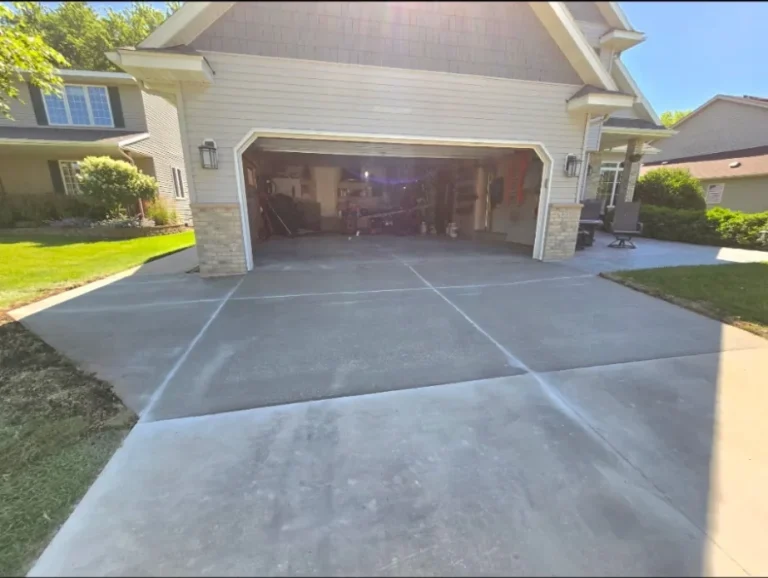
Concrete driveways in Stewartville cost more per square foot installed than asphalt up front. Concrete lasts 30 to 50 years with minimal maintenance. Asphalt needs seal coat every 3 to 5 years and full replacement at 20 to 25 years. When you run the full-life numbers for a typical Olmsted County driveway, concrete costs less over the ownership period of the home.
Upfront Cost: Concrete Costs More, Asphalt Costs Less
A standard 500 sq ft concrete driveway in Stewartville with Class 5 base, half-inch rebar, and a broom finish is priced by site conditions, access, and whether an old driveway needs removal. The same 500 sq ft in asphalt costs roughly half as much up front. That is a real difference in initial outlay, and for homeowners on a tight budget at the time of the project, asphalt is a legitimate choice. We pour concrete and we will still tell you that directly, because a homeowner who makes an informed decision will refer us the next time. A homeowner who felt sold into the wrong material for their situation will not.
The upfront gap between concrete and asphalt narrows at larger project sizes because both materials have mobilization costs that are spread over more square footage on a bigger driveway. A 200 sq ft short driveway apron in concrete is a high per-sq-ft project; a 1,200 sq ft driveway is more efficient to bid. If you are comparing quotes from a concrete contractor and an asphalt contractor on the same project, ask both for an itemized breakdown: excavation, base preparation, material, and finish. It reveals whether the gap is in the material or in how much base prep each contractor is actually including.
Minnesota Freeze-Thaw Performance: Where the Gap Widens
Asphalt and concrete handle Minnesota freeze-thaw very differently, and this is where the long-term comparison changes. Asphalt is a flexible pavement; it is designed to move slightly with temperature and seasonal frost without cracking. That flexibility is an advantage in the first 10 to 15 years of the driveway’s life in Minnesota. Asphalt accommodates minor sub-base movement without generating through-cracks the way rigid concrete can. The problem is that flexibility becomes a liability as the material ages. Asphalt oxidizes and loses its plasticity over time, becoming brittle. By years 15 to 20, an asphalt driveway in Minnesota is carrying heavy freeze-thaw stress on a surface that has lost most of its flexibility, and cracking and pothole formation accelerate sharply in that window.
Concrete is a rigid pavement. It resists frost movement by being strong enough to bridge minor sub-base irregularities rather than following them. The durability of concrete in Minnesota freeze-thaw comes from two things: air-entrained mix design (which we use on every driveway we pour) and proper base preparation. Air entrainment creates microscopic voids in the concrete matrix that give freezing water room to expand without generating damaging internal pressure. The result is a concrete driveway in Stewartville that can handle 30 to 50 freeze-thaw cycles per year, which Olmsted County routinely sees, without the surface scaling that happens when non-air-entrained concrete is used. We have seen concrete driveways in this area that are 40 years old and still in good functional shape because they were poured correctly.
De-Icing Salt: The Biggest Practical Difference
This is the comparison point that matters most to Stewartville homeowners who deal with road salt tracked in from vehicles and who use de-icers on their driveways. Asphalt is relatively tolerant of chloride-based de-icers, particularly in its middle years. The salt does not chemically attack the asphalt binder the way it attacks concrete paste. Concrete, by contrast, can be damaged by chloride de-icers, specifically calcium chloride and sodium chloride (rock salt), particularly in the first two winters after placement. Chloride ions penetrate the concrete matrix and cause surface scaling by disrupting the freeze-thaw behavior in the near-surface paste layer. A concrete driveway sealed with a penetrating silane-siloxane sealer, applied 30 days after placement and every 3 to 5 years thereafter, dramatically reduces chloride penetration and extends the surface life.
The practical implication for Stewartville homeowners: if you pour a concrete driveway and want it to perform for 40 years, use sand or traction grit for ice control rather than rock salt, and apply a penetrating sealer. Neither of those steps is expensive or difficult. If you are not willing to change your de-icing habits and do not want to maintain a sealer, asphalt is genuinely a better fit for how you will actually use the driveway. We would rather have that conversation up front than hear about a scaling concrete driveway five years later.
Lifetime Cost: Running the Full Numbers
The argument for concrete on lifetime cost is straightforward. A concrete driveway in Olmsted County, poured correctly with proper base prep and air-entrained concrete, should last 30 to 50 years with no major intervention. It needs a penetrating sealer every 5 years or so, and control joint caulking should be refreshed every 10 years. Those are the maintenance costs: low and predictable. Asphalt needs seal coat every 3 to 5 years, a recurring line for a standard residential driveway. Minor crack filling happens in between seal coats. At year 20 to 25, asphalt typically needs full removal and replacement, which resets the clock on the initial installation cost and adds another full project mobilization charge.
On a 500 sq ft driveway with a 40-year ownership horizon, concrete’s higher install cost is offset by only light sealing over four decades, while asphalt’s lower install cost is eaten up by a decade of seal coats, a full replacement around year 20, and then another round of seal coats on the new surface. By the end of the window the asphalt path costs more all-in. That math shifts further toward concrete on longer ownership horizons and on larger driveways where replacement costs more. The crossover point for most Stewartville driveways is around year 15, after which the concrete option has lower cumulative cost per year.
Resale Value and Curb Appeal
A concrete driveway reads as a permanent improvement to the property in a way that asphalt does not. Real estate professionals in the Rochester area generally agree that concrete adds more to appraised value than asphalt, and the gap is larger on higher-value homes where buyers expect concrete driveways as a standard feature. A new asphalt driveway looks clean and reads as maintained at the time of sale; a concrete driveway, particularly with a stamped apron or decorative edge, reads as a quality feature that cost real money and will not need replacement. For homeowners planning to sell within 10 years, the resale value argument for concrete is particularly strong because the driveway will still look new at the time of sale and will not have started the mid-life deterioration cycle that asphalt shows around year 15.
There are situations where asphalt is the right call despite all of this. If the existing sub-base is problematic or highly variable across the driveway footprint, asphalt’s flexibility tolerates that variability better than rigid concrete. If a driveway has a very steep grade with sharp directional changes, asphalt allows saw cuts at the turns to relieve stress in ways that concrete does not. If the homeowner’s budget is constrained and the driveway needs to happen now rather than later, asphalt with a solid base is better than no driveway. We can help you think through which situation applies to your property.
Stewartville Driveway Material FAQ
How much does a concrete driveway cost in Stewartville MN in 2026?
A standard residential concrete driveway in Stewartville is priced per square foot installed, all-in, including excavation, Class 5 base, rebar, concrete, and broom finish. Old driveway removal, tight site access, or custom finishes add cost. We provide written quotes after a free site visit, so you have an exact number before committing.
Does concrete crack more than asphalt in Minnesota winters?
Not when it is poured correctly. Air-entrained concrete with proper base preparation handles Minnesota freeze-thaw without cracking. The concrete driveways that crack are typically either poured without air entrainment, on poorly-compacted or inadequately-drained sub-base, or both. Asphalt also cracks, particularly after year 15 when oxidation has made it brittle. The cracking patterns look different but both materials fail when the sub-base fails.
Can I use rock salt on a new concrete driveway?
Not in the first two winters. Chloride de-icers on fresh concrete that has not fully cured can cause surface scaling. After the first two winters, use sparingly. A penetrating silane-siloxane sealer applied 30 days after pour and refreshed every 5 years provides significant protection. Sand and traction grit are always safer than salt on concrete and work just as well for traction.
How long before I can drive on a new concrete driveway?
Wait 7 days before driving passenger vehicles on a new concrete driveway. Seven days gets the concrete to approximately 70 percent of design strength, which is adequate for normal vehicle loads. Heavy trucks and equipment should wait 28 days. Do not park in one spot for extended periods during the first month, as oil drips and standing loads on partially-cured concrete can leave impressions.
Is concrete always better than asphalt for Olmsted County driveways?
Not always. If the sub-base is highly variable or the grade is steep with directional changes, asphalt’s flexibility handles those conditions better. If the project budget requires it now rather than later, a good asphalt installation beats waiting. For most standard residential driveways in Stewartville, though, concrete wins on lifetime cost and long-term performance when poured with proper base prep and air-entrained mix.
Talk Through Your Driveway Options
We will walk the site, look at the sub-base and grade, and give you a written quote so you can compare the actual numbers for your specific driveway.
Free Site Visit (507) 735-8820Read our driveways page · More posts · Get a free site visit