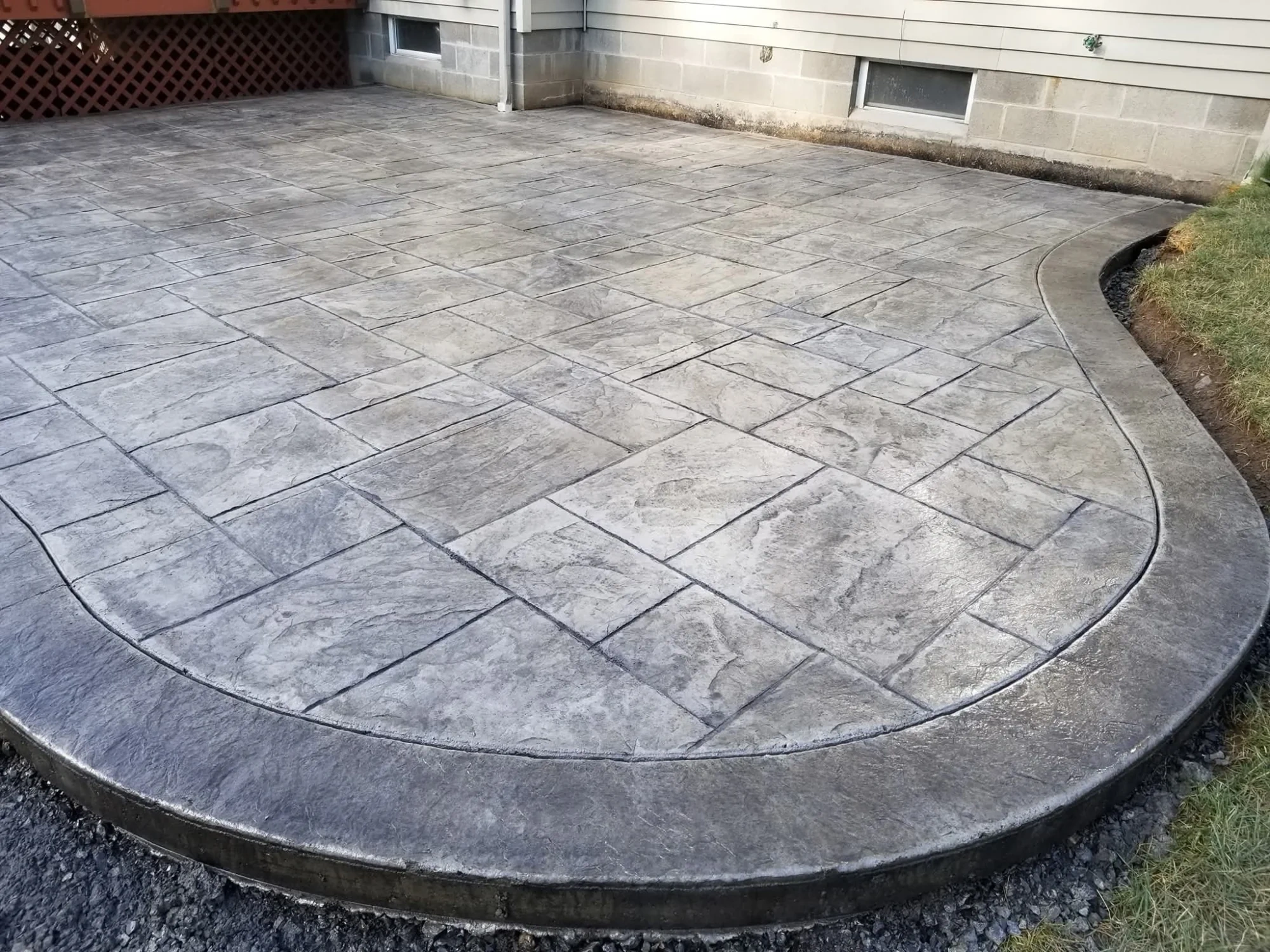
Most Stewartville patios we pour are 400 to 600 sq ft, four inches thick, broom finish or slate stamp. Exposed aggregate and custom integral color are the upgrades homeowners ask for most in 2026. Every patio gets a 4-inch Class 5 compacted base and half-inch rebar before concrete ever touches the forms.
Finish Options: What Works in Olmsted County’s Climate
The finish you pick for a Stewartville patio is not just cosmetic. It determines how the surface handles freeze-thaw cycles, snowmelt with road salt tracked in from boots, and direct UV through Minnesota summers. Broom finish is the workhorse. A medium-bristle drag across fresh concrete creates a texture coarse enough for traction when wet and fine enough that furniture legs sit flat. It costs the least and holds up the longest with minimal maintenance. For homeowners who want more, a stamped slate or ashlar pattern adds visual weight and texture without sacrificing durability. The key with stamped work in Minnesota is the concrete mix: you need air-entrained concrete with 6 to 7 percent air voids to survive freeze-thaw without surface scaling. A stamped patio sealed with a penetrating sealer every three to four years will hold its look for 25 years or more.
Exposed aggregate is the other finish we see a lot in Stewartville. You place the concrete, let the surface set to a stiff plastic state, then wash the top layer of cement paste off to reveal the stone underneath. The result is a natural-looking surface with excellent grip. The stone aggregate stays well-bonded because it was cast into the slab, not applied after. One note: exposed aggregate is not the right call if your patio will see significant foot traffic with bare feet. The texture is coarser than broom finish and can be uncomfortable underfoot. For entertainment areas with patio furniture, it works well. For pool decks or spots where kids play, broom or stamped is a better fit.
Sizing a Stewartville Patio: The Numbers That Actually Work
We pour a lot of 400 to 600 sq ft patios in Stewartville and the surrounding Olmsted County area. That range covers most household needs: a dining table for six, a grill station, a small seating group. If you are planning a full outdoor kitchen or a large pergola, step up to 700 to 900 sq ft. The most common mistake homeowners make is sizing the patio to the current furniture and finding out two years later it feels cramped. A 10×10 patio looks generous in an empty backyard. With a table, chairs, and a grill, it reads small. A 16×24 or 20×20 patio gives you real usability.
One framing question worth asking before you finalize size: what is the intended use? If this patio connects directly to a back door and will serve as the primary outdoor living space, go larger. If it is a secondary patio at the back of a yard or garden area, a 12×16 works fine. We can walk the site with you and lay out the dimensions on the ground with stakes so you can see what 400 vs 600 sq ft actually looks like in your specific yard before we order a yard of concrete.
Drainage and Grade: Non-Negotiable in Minnesota
Stewartville gets around 33 inches of precipitation per year, and a meaningful portion of that comes as snowmelt in a short window during March and April. A patio that drains slowly becomes a problem fast: pooling water refreezes, puts pressure on the slab edges, and makes the surface unsafe. We build a minimum 1/8 inch per foot of slope away from the house foundation into every patio we pour. For patios wider than 16 feet, we sometimes add a secondary slope axis to pull water toward a specific corner rather than spreading it across the back edge. If your yard grades back toward the house, we address that with a small concrete swale or channel drain embedded in the slab before finishing.
Frost depth in Olmsted County reaches 48 to 54 inches in a hard winter. That matters for patio footings if you are attaching a pergola or overhead structure. The patio slab itself floats freely, which is correct: a floating slab can heave and settle slightly with the seasons without cracking, because it has no fixed anchor points to fight. If you bolt a pergola post to a patio slab without a separate frost-depth footing, the post goes with the slab when it heaves and that creates structural issues. We can integrate post sleeves with proper footings into the patio pour if a covered structure is in the plan.
Integral Color vs Topical Stain: What Lasts
Integral color is mixed into the concrete before the pour. It goes all the way through the slab, so if the surface chips or weathers over decades, the color underneath matches. It is the more expensive option up front and the more durable option long term. Topical stain is applied after the concrete has cured, usually acid-based for a variegated, mottled look or water-based for more uniform coverage. Topical stain on an exterior slab in Minnesota needs resealing every two to three years to stay looking sharp. Integral color needs a sealer too, but the color itself does not wear away. For a Stewartville patio that will get 30 years of use, integral color is the right investment.
Color selection matters more than most homeowners realize at the planning stage. A concrete patio that reads as medium gray against a light limestone house foundation can look fine; that same gray against a dark brown cedar board house may read as flat and institutional. We have color samples at our office and can bring a sample board to the site visit. If you are choosing between stamped and integral color, the two can be combined: a stamped slate pattern with a warm buff integral color is one of the most popular finishes we do in this area. It reads as natural stone from across the yard and holds up to Olmsted County winters without the maintenance burden of actual stone pavers.
What Goes Under the Slab: The Part You Cannot See
Every patio we pour in Stewartville gets the same base regardless of finish choice or budget: 4 inches of Class 5 compacted aggregate, half-inch rebar on 24-inch grid, and 4 inches of air-entrained concrete with a minimum 4,000 psi mix. This is not optional for Minnesota. The reason concrete patios crack prematurely is not the concrete itself; it is what happens underneath. When a base settles unevenly because it was not properly compacted, the slab loses uniform support and the unsupported span cracks under load or frost pressure. A 4-inch Class 5 base compacted in lifts with a plate compactor gives the slab a stable, uniform bed that resists seasonal movement.
Half-inch rebar matters specifically in the Minnesota climate context. Wire mesh, which some contractors use as a cheaper alternative, sits near the bottom of the slab after concrete placement and provides almost no tensile reinforcement across the mid-slab where freeze-thaw stress concentrates. Rebar on 24-inch centers holds the slab together as a single unit when ground movement tries to separate it. We have pulled out cracked patios poured by other contractors over the years, and in almost every case the sub-base was thin and the reinforcement was wire mesh. The slab on top was adequate. Everything below it was not.
Stewartville MN Concrete Patio FAQ
How much does a concrete patio cost in Stewartville MN?
A standard 400 sq ft broom-finish patio in Stewartville with proper base prep and half-inch rebar is the entry-level build. Stamped and integral color work pushes cost higher for the same footprint. We provide written quotes after a free site visit, so you have an exact number before any commitment.
How thick should a concrete patio be in Minnesota?
Four inches is the minimum for a residential patio in Minnesota. We pour four-inch slabs on a compacted Class 5 base, which gives you the freeze-thaw durability you need without going to five or six inches unless the patio will see vehicle traffic. Thicker is not automatically better; proper base prep and air entrainment matter more than slab depth for typical patio applications.
What concrete finish holds up best through Minnesota winters?
Broom finish and stamped concrete both hold up well when poured with air-entrained concrete at 6 to 7 percent air content. Exposed aggregate is also durable but requires a slightly coarser surface texture. The mistake that leads to winter surface scaling is using non-air-entrained concrete or applying de-icing salts directly to the slab in the first two winters after pouring. Sand and traction grit are fine; salt is not.
Can I attach a pergola or overhead structure to a concrete patio?
Yes, but the posts need their own frost-depth footings rather than being bolted to the floating slab. In Olmsted County, that means footings that extend 48 to 54 inches below grade. We can integrate post-sleeve anchors into the patio pour so the footings align perfectly with the slab layout. Planning this before the pour is far less expensive than coring through finished concrete afterward.
How soon can I use a new concrete patio?
Light foot traffic is fine at 24 to 48 hours after the pour, depending on temperature and humidity. Furniture and grill placement should wait seven days. Full design-strength (28-day cure) is when the slab is at its rated 4,000 psi. In cooler weather below 50 degrees, we use blanket curing to maintain temperature and extend the cure window appropriately.
Free Site Visit for Stewartville Homeowners
We walk your yard, lay out the dimensions, and give you a written quote before you commit to anything. No pressure, no obligation.
Free Site Visit (507) 735-8820Read our stamped concrete page · More posts · Get a free site visit