Broom is the workhorse: cheapest to maintain, best traction, least interesting to look at. Exposed aggregate is durable and forgiving of wear but committed. Stamped gives you pattern and color at a scale nothing else matches, and asks for sealer forever. Polished belongs indoors and does not belong on your driveway. Most of the wrong choices we see come from picking a finish for a photograph rather than for the place it has to live.
A homeowner shows Pedro a picture on a phone, usually taken somewhere with a much friendlier climate, and asks whether we can do that. Frequently we can. The more useful conversation is whether you want it here, on that particular slab, with our winters and the way you actually use the space. This is the rundown we give in person, written down.
Broom: The One Most People Should Choose
A broom finish is exactly what it sounds like. Once the slab is floated smooth, the finisher drags a broom across it, leaving a fine directional texture. It is the default outdoor finish in Minnesota, and it is the default for good reasons rather than lazy ones.
Traction is the main one. Those small ridges give shoes and tires something to grip when the surface is wet, frosted or gritty, which on a sloped driveway or a walk that runs to a door is not a small consideration. Nothing else on this list matches it underfoot in winter.
The honest cost is that it looks like concrete. If you want your outdoor space to have character, a broom finish is not going to supply it. That is a real limitation and worth weighing, but plenty of very good patios are broom-finished with the character coming from shape, edge detail and layout instead.
Exposed Aggregate: Durable and Committed
Exposed aggregate works by removing the top layer of paste so the stone within the concrete shows at the surface. You end up looking at the actual rock in the mix, which gives a natural, varied appearance that reads very differently from a plain gray slab.
It weathers well. Because the surface is stone rather than a thin skin of paste, it holds up to traffic and does not show wear patterns the way a smooth finish can, and the visual texture hides dirt and staining that would be obvious elsewhere. Traction is generally good, though it depends on how coarse the exposure is.
What to know before committing
The surface is irregular, which means bare feet find it rougher and shoveling drags across a bumpy surface rather than gliding. It also cannot be undone. Where a smooth slab could theoretically be resurfaced or coated later, an exposed surface is the surface. Decide once.
Stamped: The Most Look for the Money, With Ongoing Duties
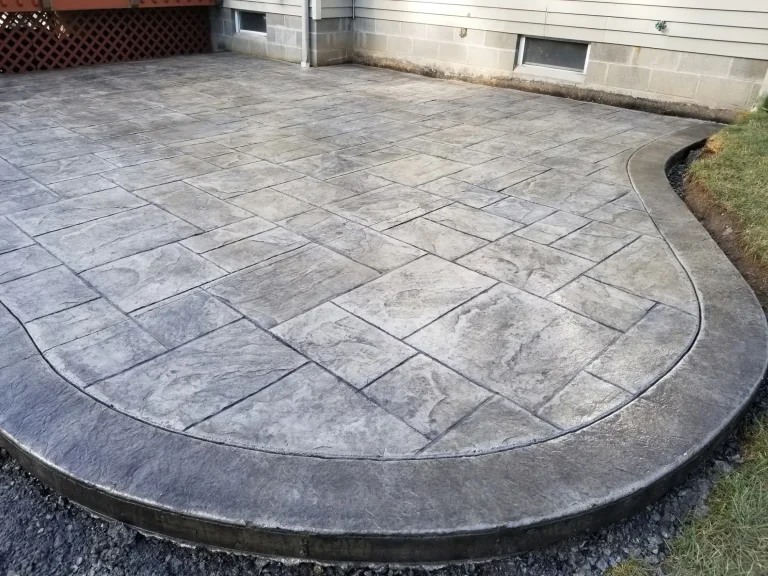
Stamped concrete presses a texture into the slab while it is still workable, producing stone, slate or plank patterns, with color from pigment through the mix and a second tone dropped into the low points at stamping. It is the finish people picture when they imagine an upgraded outdoor space.
What it does uniquely well is scale. A large continuous patio with a stone appearance would be slow and expensive to build out of individual pieces, and it would have joints between every one of them. Stamped work gives you one sound slab with the appearance you wanted, over an area and a shape that would otherwise be impractical. That is the genuine argument for it, and it is a strong one.
The duties are real too, and we would rather you hear them now. Sealer is not optional on stamped work: it holds the color and it limits how much water gets into the surface. It wears and needs refreshing periodically for the life of the slab. Deicing chemicals are hard on it and we ask owners to keep them off entirely. And the surface tone does shift over the years as the release color weathers, which is why the pigment in the mix matters.
It also is not stone up close, and we say that to every customer before they sign rather than after. From a few feet away it reads convincingly. Standing on it, you can tell. If that will bother you, better to find out now. The stamped concrete page goes further into pattern and color selection.
Polished: An Interior Finish, Full Stop
Polished concrete is mechanically ground and refined until the surface takes on a sheen, with the level of shine and how much aggregate shows both being choices. It produces a hard, dense, easy-to-clean floor that suits a shop, a barn interior, a garage or a finished basement extremely well.
Indoors it is close to ideal. Nothing to peel or delaminate the way a coating can, easy to sweep and mop, and it takes equipment traffic without complaint. On a pole barn or shop floor it is often the best value on this whole list over the life of the building.
Outdoors it is the wrong answer and we will say so. A smooth polished surface with water or frost on it is a hazard, and the freeze and thaw cycling that outdoor slabs live with is hard on a refined surface. When somebody asks for a polished driveway, we talk them out of it. That is not us protecting ourselves from a warranty claim; it is that the thing they are picturing would genuinely be worse to own.
How We Actually Help People Decide
Start with the use, not the look. Who walks on it, in what shoes, at what time of year? Does anybody get across it with a cane or a stroller? Does the space get shoveled, and by whom? A finish that would be lovely on a sheltered courtyard can be a genuine nuisance on a north-facing walk that ices up every February.
Then be honest about maintenance appetite. Some people enjoy keeping a decorative surface looking sharp and will happily reseal on schedule. Others will not, and there is no shame in that. Choosing stamped and then never touching it produces a worse outcome in ten years than choosing broom and being content. Matching the finish to the owner’s actual habits is a large part of the job.
And look at the real material before committing. We put down a sample and let it cure so you are judging the finished, dry color outdoors on your own ground, rather than a chip in a brochure under shop lighting. Wet concrete always looks darker than it will end up, and that surprise is entirely avoidable.
Underneath all four finishes, the work does not change. Same excavation, same compacted base, same reinforcement set where it belongs, same joint plan, same mix built for outdoor Minnesota. The finish is the part you see. The rest is the part that decides whether you still like it in fifteen years. Have Pedro come look at the space, and he will tell you which of these belongs there, including when the answer is the cheaper one. The visit costs nothing and we put the numbers in writing. Call (507) 735-8820 or reach us through the contact page.
Choosing a Finish: Common Questions
Which finish holds up best to a snow shovel?
Broom, comfortably. The texture is shallow and directional, so a shovel or a blade rides across it cleanly. Exposed aggregate is rougher to scrape. Stamped work handles shoveling fine but the sealer takes the wear, which is one reason it needs refreshing. If your slab gets cleared constantly all winter, that should weigh on the decision.
Can I put a decorative finish on my existing slab?
Sometimes, and it depends entirely on the condition of what is there. A sound, stable slab can be a candidate for a resurfacing or coating system. A slab that is cracking, moving or scaling is not, because anything you put on top inherits the problem underneath. We would look at it in person before saying yes.
Does colored concrete fade?
The surface tone weathers, and the pigment mixed through the slab is far more stable. That is exactly why we do not rely on surface color alone on work meant to last. Sun, rain and shoveling all soften the top over several seasons. Maintained sealer slows it considerably, but expect some change and choose a color you will still like once it has mellowed.
Is a decorative finish worth it if I might sell in a few years?
Often yes for a patio or an entry, which is where visitors form an impression. Less so for a hidden side walkway. But be realistic that a decorative surface only helps if it has been maintained. A tired, unsealed stamped patio does less for a buyer than a clean broom-finished one, so the maintenance question comes back around.
Can different finishes be used in one project?
Yes, and done well it looks intentional and considerably better than one finish everywhere. The key is planning the transitions rather than discovering them. Where two surfaces meet, that line should be a designed edge with the joint layout thought through on both sides. We map it out on the ground before anything gets dug.
Look at a Real Sample Before You Decide
Pedro walks the space, talks through what each finish will be like to own here, and puts the whole job in writing. No pressure, no cost for the visit.
Book a Site Visit (507) 735-8820