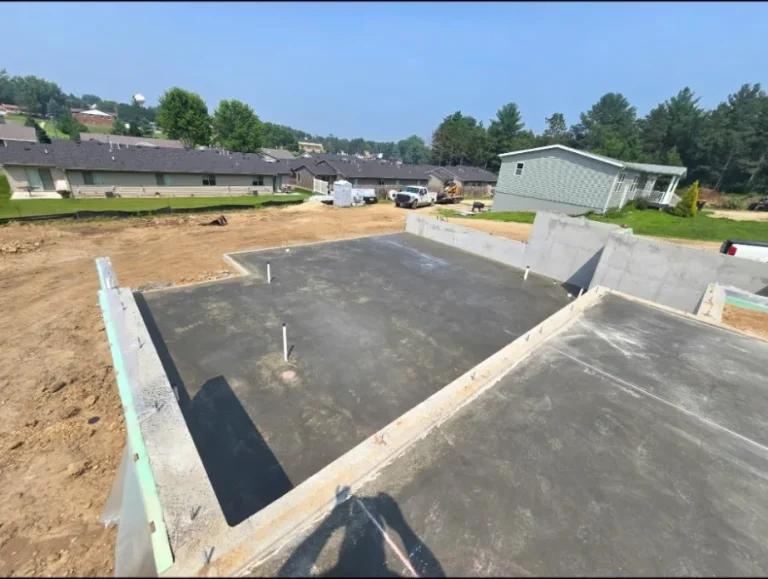
Concrete in Goodhue County does not fail because somebody bought the wrong bag of cement. It fails because the ground under it froze, swelled, and set the slab back down somewhere else. Anything bearing weight gets dug below the frost line. Everything else lives or dies on drainage and compaction. The mix matters, but it is the last thing on that list, not the first.
Pedro gets called out to look at broken concrete more often than most people would guess, and the conversation almost always opens the same way: the homeowner wants to know what went wrong with the concrete. Nine times out of ten nothing went wrong with the concrete. The concrete did what it was told by the dirt underneath it. Frost got into that dirt, the dirt got bigger, and a rigid slab sitting on top of ground that changes shape has exactly two options. It tilts, or it breaks.
Frost Does Not Push On the Slab. It Pushes On the Water.
The thing lifting your sidewalk is not cold, exactly. It is water. Soil in this part of Minnesota holds moisture in the spaces between its particles, and when that moisture freezes it takes up more room than it did as liquid. Multiply a small expansion across every pore in a few feet of soil and you get real vertical movement, enough to raise a corner of a garage apron by an amount you can see from across the yard.
Depth matters too, and this is the part people find counterintuitive. Frost does not stop at the surface. It works down through the soil column over the course of the winter, and the ground below where it reaches never freezes at all. That stable zone is the whole basis of how anything permanent gets built here.
Below the Frost Line Means Something Specific
When we say a footing goes below frost, we are saying it bears on soil that stays unfrozen all winter. That is the point. A footing resting in the frozen zone gets lifted with everything else around it, then dropped again in spring, and it does not come back to exactly where it started. Repeat that for a few winters and the structure sitting on it has visibly moved.
What we dig below frost on a residential job is anything that has to hold an elevation: footings under a stoop, piers under posts, the bearing points where a slab ties into a structure. What we do not dig below frost is a patio or a driveway, because nobody excavates a whole driveway that deep and nobody needs to. Those slabs are designed to float, which means they are allowed to move a little as long as they move evenly.
Floating is not the same as unsupported
A floating slab still needs ground that behaves. It rides on a base we built and compacted specifically so it drains and does not hold water where frost can find it. Even movement across the whole slab is invisible. Uneven movement is what cracks it.
Mixing the two is the classic mistake
The ugliest failures we see come from a floating slab poured hard against something that sits on deep footings, with nothing between them. The footing stays put. The slab moves. Something has to give, and it is never the footing.
What Heaving Actually Looks Like in a Yard
Homeowners often do not recognize heaving when they are standing on it, because it does not look dramatic. It looks like a walkway where one section sits proud of the next and catches the toe of your boot. It looks like a garage slab that used to meet the driveway flush and now has a lip. It looks like a stoop that has pulled a visible gap away from the house, or a door that scrapes in March and swings clean in July.
Water is usually implicated somewhere. A downspout dumping next to a slab edge, a yard that pitches back toward the house, a low spot that ponds every spring: all of those load the soil right where you least want it loaded. Fix the drainage and you have removed most of the fuel.
Prep Decides More Than the Mix Does
Here is the part that costs money and never shows up in a photograph. Before any concrete gets ordered for a job in town we strip the topsoil and organic material out, because that stuff compresses and rots and was never going to hold anything. Then we bring the base back in layers, compacting as we go, so the material is genuinely dense rather than just piled to grade. Then we set the pitch so water leaves.
A crew that skips that sequence can still hand you a slab that looks perfect on the day the forms come off. The difference does not show up for a few winters. That gap between when the corner gets cut and when the failure appears is exactly why it keeps getting cut, and it is the reason this company exists in the first place.
The mix matters, and outdoors here it needs the air in it that gives freezing water somewhere to go. But a good mix on bad ground is still a failure. Bad ground wins.
What This Means When You Are Getting Bids
If you are collecting numbers on a driveway or a patio and one is meaningfully cheaper than the rest, the savings are almost never in the concrete. Ready-mix costs what it costs and everybody buys it from the same place. The savings are in excavation depth, in base material, in whether anybody compacted anything, and in whether the reinforcement is real and positioned or ceremonial.
So ask about the ground. Ask how deep they are digging, what they are putting back, how they are compacting it, and where the water is supposed to go. A contractor who has thought about your site will have an answer ready and will probably be glad you asked. A contractor who wants to talk only about the finish is telling you where their attention is.
We would rather lose a job to a fair comparison than win it because somebody did not know what to compare. When we walk a site in Cannon Falls we say plainly what the soil and the grade are going to demand, and if the honest answer is that your existing slab has years left in it, we will tell you that instead of selling you a tear-out. The visit costs nothing either way, and we put the numbers in writing so you can hold them up next to anyone else’s.
Frost and Concrete: Common Questions
My sidewalk lifted one winter. Will it settle back on its own?
Partly, usually, but rarely all the way. Frost lifts the slab, and when the ground thaws it relaxes back toward where it started without quite getting there. Each cycle leaves a little residue. If the lip between sections is small and it visibly shrinks in summer, watching it another season is reasonable. If it has grown year over year, the ground under it is holding water and that needs solving before anything gets repoured.
Would thicker concrete have prevented this?
Not really. A thicker slab spans a soft spot a bit better, and on drive lanes and heavy loads we do build up. But frost lifts whatever is above it regardless of thickness, so pouring deeper is an expensive way to address the wrong problem. That same money spent on excavation, base and drainage does far more.
Does every slab need footings below the frost line?
No, and building every slab that way would be a waste. Anything that must hold an elevation relative to a structure gets footings below frost. Flatwork like driveways and patios is designed to float on a properly built base and move evenly with the seasons. The trouble comes from mixing the two systems without planning the joint between them.
Can drainage work fix an existing heaving problem?
Sometimes, and it is worth checking before spending on concrete. Rerouting a downspout, regrading a low spot, or cutting off water that runs toward a slab edge can quiet down a slab that has been moving for years. It will not repair damage already done, but it can stop the movement getting worse. We look at that first because it is the cheaper answer.
How long before a new slab is at full strength?
Concrete gains strength quickly at first, then keeps going more slowly for a long while, with about a month being the usual benchmark for full design strength. Foot traffic comes well before that, and vehicles somewhere in between. We block the site off on pour day and walk you through which day is safe for what before we leave.
Have Pedro Look at the Ground
We will read the grade, check where water goes, and tell you honestly whether your slab needs replacing or has good years left. Priced in writing, line by line.
Book a Site Visit (507) 735-8820